Showing posts with label forex signal provider. Show all posts

Thursday, 13 October 2022

South Korea: BoK raised rates by 50 bps – UOB

 Economist at UOB Group Ho Woei Chen, CFA, comments on the latest interest rate decision by the Bank of Korea (BoK).


Key Takeaways

“Bank of Korea (BoK) ratcheted up its benchmark base rate by an outsized 50bps to 3.00% in Oct. This was the second time that the central bank had hiked by a 50bps pace following a similar move in Jul. The strengthened policy move was in response to the high inflation as well as sharp depreciation in the won which was seen adding more inflationary pressure through higher imported prices.”

“Despite opting for a larger 50bps hike, BoK’s tone was evidently more downbeat as Governor Rhee Chang-yong flagged weaker growth outlook for the global and South Korean economies.”

Wednesday, 21 September 2022

Malaysia: Trade balance figures came on the strong side – UOB

 UOB Group’s Senior Economist Julia Goh and Economist Loke Siew Ting review the latest trade balance figures in Malaysia.


Key Quotes

“Malaysia’s external trade surprisingly posted stronger gains last month, in part due to year-ago low base effects. Export growth hit a 16-month high of 48.2% y/y in Aug (Jul: +38.0%, UOB est: +30.5%, Bloomberg est: +34.3%) as a result of a triple-digit gain in re-exports (+112.5%) versus a double digit gain in domestic exports (+34.8%). Imports posted the largest ever annual growth on record, at 67.6% (Jul: +41.8%, UOB est: +48.0%, Bloomberg est: +48.0%). This brought trade surplus higher to MYR16.9bn from MYR15.6bn in the preceding month.”

“Increased shipments of commodity-based and electrical & electronic (E&E) products amid stronger demand from almost all trading partners were key drivers of robust export growth in Aug. Exports of petroleum products, liquefied natural gas (LNG) and optical & scientific equipment registered the highest monthly value in the month. Exports to the ASEAN region, South Korea and Hong Kong improved by more than 50% while shipments to the US jumped the most in 15 months by 38.2%.”

“Given that Aug’s export reading defied our earlier expectations of a soft patch in the greater part of 2H22 and the 30.3% year-to-date export growth moved further apart from our full-year growth target of 18.0%, we now upgrade our export growth projection to 26.0% for 2022 with statistical base and commodity price effects remaining wildcards for the outlook. We expect the recent retreat in major commodity prices and lingering global uncertainties particularly a global recession risk to weigh on Malaysia’s export outlook going into 2023, leading to a modest export growth of 1.5% next year.”


Thursday, 15 September 2022

Silver Price Analysis: XAG/USD maintains a large top, further downside ahead – Credit Suisse

 Silver maintains the top analysts at Credit Suisse have been highlighting since mid-May. Therefore, XAG/USD is expected to decline towards the $15.56 support.


Break above $21.39 remains needed to negate the top

“Silver has risen back above the crucial 61.8% retracement support of the whole 2020/21 upmove at $18.65/15, however, still maintains a large top below $21.39 and we hence expect further downside from here towards the $15.56 support from a technical analysis perspective.”

“Next resistance is seen at $20.87 and above $21.39 remains needed to negate the top.”

Thursday, 8 September 2022

Euro holds above 2-decade low before ECB decision

 LONDON (Reuters) - The euro was hovering above Tuesday's two-decade low on Thursday as investors awaited a policy decision from the European Central Bank (ECB) and comments from the head of the Federal Reserve for insight on the path for global monetary tightening.


The ECB is expected to raise rates by 75 basis points (bps), taking its deposit rate above zero for the first time since 2012, but the option of a smaller 50 basis point hike hasn't been ruled out.

"We expect the ECB to only do 50 basis points today, instead of the consensus view of 75," said Chris Turner, head of markets at ING. "If that's the case, we think euro-dollar probably corrects back down to about $0.99."

By 0747 GMT, the euro was trading down 0.3% at $0.99795, holding above its lowest level since late 2002 of $0.9864 as Europe's energy crisis keeps the single currency under pressure and the dollar reigns as the Fed reiterates its commitment to bring inflation down to target.

Fed Chair Jerome Powell is scheduled to participate in a discussion at 1310 GMT -- overlapping with ECB chief Lagarde's post-decision press conference -- with Fed officials soon due to enter into a blackout period prior to the central bank's Sept. 20-21 meeting.

Recent Fed rhetoric has continued to be hawkish overall.

Boston Fed President Susan Collins said on Wednesday that bringing inflation back down to 2% is the Fed's "Job One," while Vice Chair Lael Brainard said tight monetary policy will continue "for as long as it takes to get inflation down."

Money markets lay 79% odds that the Fed will hike by another 75 basis points at this month's meeting, which would increase the fed funds rate to 3.0% to 3.25%.

The U.S. dollar index, which measures the currency against six major counterparts, edged up 0.1% lower to 109.82, after hitting a peak at 110.79 on Wednesday, a level not seen since June 2002.

Sterling weakened 0.4% to $1.1486, heading back toward the previous day's 37-year low of $1.1407, ahead of new British Prime Minister Liz Truss's announcement on her plans to tackle soaring energy bills.

Japan's yen showed some resilience on Thursday, trading little changed at 143.77 per dollar, after reaching a 24-year low of 144.99 in the previous session.

The yen has been a particular victim of recent dollar strength, partly due to its sensitivity to rising long-term U.S. yields as hawkish Fed bets ramped up and the Bank of Japan remains the holdout dovish central bank.

"Ongoing depreciation pressure on the yen has raised the probability of a change in policy (from the Bank of Japan) later this year," Goldman Sachs (NYSE:GS) analysts said in a research note.

"If the BoJ drops YCC (yield curve control), rate differentials vs the U.S. should stop widening, and the rise in USD/JPY should pause or reverse."

Officials from Japan's Finance Ministry, Bank of Japan and Financial Services Agency are meeting today to discuss global financial markets, the Ministry of Finance (MOF) said.

Meanwhile, the Aussie fell 0.5% to $0.67345, earlier tumbling as low as $0.6713, after RBA Governor Lowe said in a speech "the case for a slower pace of increase in interest rates becomes stronger as the level of the cash rate rises."

Wednesday, 7 September 2022

BOE’s Pill: All inflation forecasts are dependent on very volatile gas prices


Bank of England (BOE) Chief Economist Huw Pill is testifying on the bank’s Monetary Policy Report (MPR) before Parliament's Treasury Committee on Wednesday.


Also read: Bailey speech: Confident BOE will respond to price shock

Key comments

Goldman Sachs UK inflation forecasts are mechanical implication of wholesale gas markets.

Goldman Sachs forecasts illustrate how much market prices have changed since BOE prepared Aug inflation forecast.

Some of rise in gas prices has reversed since Goldman inflation forecast.

All inflation forecasts are dependent on very volatile gas prices.

Inflation forecast also depends on machinery by which wholesale gas prices translate into retail prices.

Politicians are considering transmission of wholesale gas prices to consumer.

Seems clear to me we will see changes in this area.

Inflation impact of future fiscal stimulus depends on details.

Supporting household incomes will boost demand, leading to slightly stronger inflation.

I would expect headline inflation to decline in short term.

Implication for inflation at monetary policy relevant horizon is unclear, given lack of detail.

Very short-term impact on government measures on inflation may not be most important thing for BOE.

Must emphasise importance of BOE inflation target as anchor, not consider new regime.

We are here to ensure fiscal policy does not generate inflation.

We think output measures of GDP are better measures of activity, as less distorted by problems with trade figures.

Hopefully quality of trade data will improve over time.

Monday, 29 August 2022

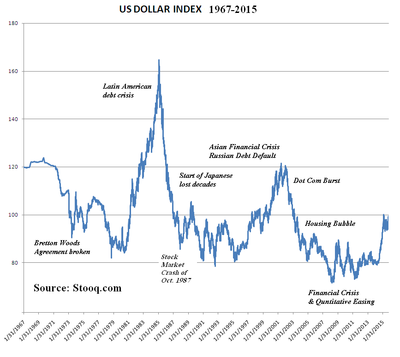
US Dollar Index Price Analysis: Immediately to the upside comes 109.77


  • DXY prints fresh cycle highs near 109.50 on Monday.
  • Further upside could revisit the September 2002 high at 109.77.

DXY extends the post-Powell rally to the area of 109.50, recording at the same time new cycle highs.

Further upside remains on the cards for the index in the near term. Against that, the surpass of the 2022 high at 109.47 (August 29) should open the door to the September 2002 top at 109.77 prior to the round level at 110.00.

In the meantime, while above the 6-month support line around 105.40, the index is expected to keep the short-term positive stance.

Looking at the long-term scenario, the bullish view in the dollar remains in place while above the 200-day SMA at 100.74.

Wednesday, 24 August 2022

When are the US durable goods orders and how could they affect EUR/USD?


US durable goods orders overview

Wednesday's US economic docket highlights the release of Durable Goods Orders data for July. The US Census Bureau will publish the monthly report at 12:30 GMT and is expected to show that headline orders rose 0.6% during the reported month, marking a notable slowdown from the 2% increase recorded in June. Orders excluding transportation items, which tend to have a broader impact, are anticipated to grow by a modest 0.2% in July as compared to a 0.4% rise reported in the previous month.

Analysts at Wells Fargo offer a brief preview of the report and explain: “Demand for goods is slowing. That is as true for business spending as it is for personal consumption. For businesses, the growing concern the economy is about to tip into recession is weighing on activity, as well as higher borrowing costs and demand largely having been pulled forward throughout the pandemic.”


How could it affect EUR/USD?

Ahead of the key data, the emergence of fresh US dollar buying drags the EUR/USD pair back closer to its lowest level since December 2002 touched the previous day. A stronger-than-expected domestic data will reinforce hawkish Fed expectations, which, in turn, should result in higher US Treasury bond yields and a stronger USD.

Conversely, a weaker report will further fuel concerns about a global economic downturn and weigh on investors' sentiment, offering some support to the greenback's safe-haven status. This, along with fears of a prolonged energy-supply crunch in the Eurozone, suggests that the path of least resistance for the EUR/USD pair is to the downside.

That said, any immediate market reaction is more likely to be short-lived as market participants might prefer to wait on the sidelines ahead of Fed Chair Jerome Powell's appearance at the Jackson Hole symposium on Friday. Nevertheless, a big divergence from the expected readings might still provide some meaningful impetus to the EUR/USD pair.

Eren Sengezer, Editor at FXStreet, meanwhile, offered a brief technical outlook for the EUR/USD pair: “On the four-hour chart, the Relative Strength Index (RSI) indicator stays well below 40 after having moved out of the oversold territory on Tuesday. Additionally, EUR/USD is yet to make a four-hour close above the descending regression channel coming from August 12. Both of these technical developments suggest that the pair's latest recovery was a technical correction rather than a reversal..”

Eren also outlined important technical levels to trade the EUR/USD pair: “In case the pair starts using 0.9950 (static level, upper limit of the descending regression channel) as support, it could face interim resistance at 0.9975 (20-period SMA) before testing parity. On the downside, 0.9900 (static level, psychological level) aligns as first support before 0.9870 (former resistance area from October 2002) and 0.9800 (psychological level).”

Wednesday, 10 August 2022

Nervous calm as dollar prepares for inflation test


Major currencies held steady on Wednesday, with traders cautious about placing large bets ahead of U.S. inflation data, which markets will scrutinise for guidance on how steeply the U.S. Federal Reserve will raise interest rates in coming months.

The figures are due at 1230 GMT. Economists expect year-on-year headline inflation to be running at a scorching 8.7%, a small retreat from June's whopping 9.1% figure. Core inflation is expected at 0.5% month-on-month.

The greenback was broadly steady, having paused a bit from a retreat that began in the middle of July.

It bought 135 Japanese yen and sat at $1.0215 per euro and $1.2089 versus sterling, all little changed on the day and largely unchanged since the start of this week.

"All eyes are on U.S. CPI," said Carol Kong, a currency strategist at Commonwealth Bank of Australia (OTC:CMWAY).

"Currencies have been quiet this week, and barring a major news event we don't expect the dollar to move out its range before the data."

Traders expect reaction to turn on the core inflation figure.

"The market will initially get more excited by a downside core CPI surprise than an upside surprise," said Deutsche Bank (ETR:DBKGn) strategist Alan Ruskin. A downward surprise would feed into hopes that falling commodity prices mean inflation can quickly recede.

"It will also play to the market's recent proclivity to buy risk dips, and will be a broad-based negative for the U.S. dollar,

Thursday, 28 April 2022

US: Weekly Initial Jobless Claims fall to 180K vs. 180K expected


  • Weekly initial claims and continued claims were broadly in line with expectations according to the latest report. 
  • The US dollar weakened as a result of weak US GDP data and ignored the latest jobless claims figures. 

There were 180,000 initial claims in the US economy in the week ending on 23 April, in line with consensus estimates and a slight decline from last week's 185,000 reading which was revised up from 184,000, according to data released by the US Department of Labour on Thursday. That meant that the four-week average of initial claims rose to 179,750 from 177,500 a week prior. 

Continued claims in the week ending on 16 April saw a slight fall to 1.408M from 1.409M a week prior, a little above the expected drop to 1.403M. The insured unemployment rate thus came in at 1.0% in the week ending on 16 April, unchanged from a week earlier. 

Market Reaction

FX markets did not react to the latest broadly as expected jobless claims report but rather reacted to weak US growth numbers, with the US dollar weakening slightly. 

Tuesday, 26 April 2022

EUR/USD eyes 2020 lows at 1.0637 as USD regains poise


 The latest candle on the four-hour chart closed below 1.0700. The Relative Strength Index (RSI) indicator on the same chart stays near 40 and the descending line coming from April 21 stays intact, highlighting EUR/USD's bearish bias in the near term. 

It's worth noting that EUR/USD will touch its weakest level since April 2017 with a drop below 1.0635. Sellers might see such a move as a profit-taking opportunity and trigger a correction in the pair. In that case, 1.0700 (psychological level) aligns as the next recovery target before 1.0730 (static level) and 1.0760 (static level).

On the downside, a daily close below 1.0640 is likely to open the door for additional losses toward 1.0600 (psychological level) and 1.0570 (static level from March 2017).

Friday, 1 April 2022

When is the US monthly jobs report (NFP) and how could it affect EUR/USD?


US monthly jobs report overview

Friday's US economic docket highlights the release of the closely-watched US monthly jobs data. The popularly known NFP report is scheduled for release at 12:30 GMT and is expected to show that the economy added 490K new jobs in March, down from the 678K reported in the previous month. The unemployment rate is expected to edge lower to 3.7% from 3.8% in February. Apart from this, investors will take cues from Average Hourly Earnings amid expectations for a more aggressive policy response to contain high inflation. 

As Joseph Trevisani, Senior Analyst at FXStreet, explains: “It is becoming clear that the reconstitution of the labor market is not enough to prevent inflation from crippling the economic recovery. The crucial factor is consumer spending. About two-thirds of US economic activity can be directly traced to personal expenditures. The availability of jobs and the ability of workers to seek higher wages are the main supports for consumer spending.”

Monday, 28 March 2022

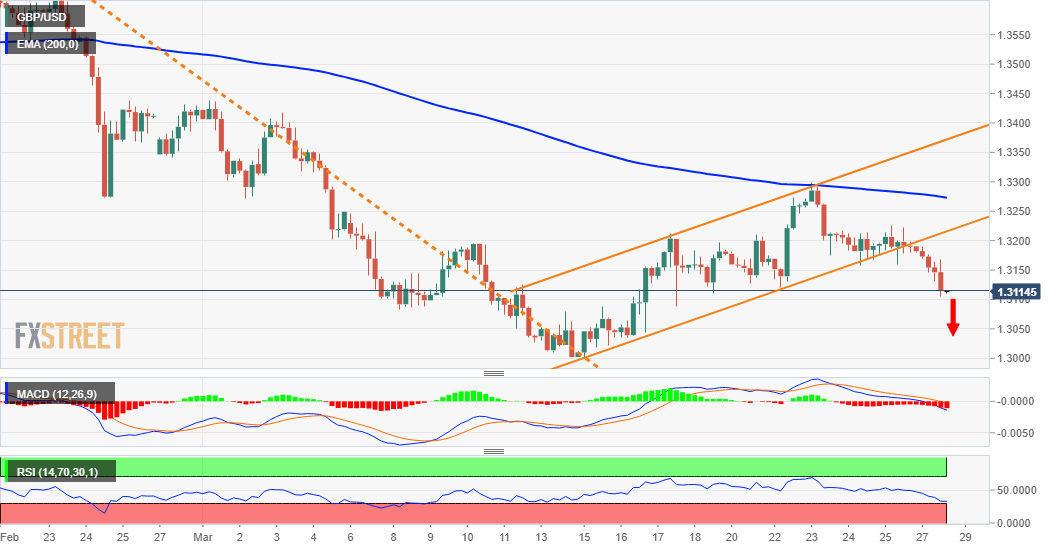
GBP/USD Price Analysis: Seems vulnerable near 1.3100 mark, bearish flag breakdown in play

The GBP/USD pair extended last week's retracement slide from the 1.3300 mark, or the 200-period EMA on the 4-hour chart and witnessed some follow-through selling on Monday. This marked the fourth successive day of a negative move and dragged spot prices to over a one-week low, around the 1.3110 region during the mid-European session.

The US dollar continued drawing support from rising bets for a 50 bps Fed rate hike move at the May meeting. Conversely, the sterling was weighed down by dovish remarks from the Bank of England Governor Andrew Bailey, saying that we are starting to see evidence of a growth slowdown. This, in turn, exerted downward pressure on the GBP/USD pair.

 Looking at the broader picture, the pair on Friday confirmed a break through an ascending trend channel, which constituted the formation of a bearish flag pattern. Sustained weakness below the 1.3100 round-figure mark will further validate the bearish bias and set the stage for a further near-term depreciating move for the GBP/USD pair.

The next relevant support is pegged near the 1.3070 region, below which the downward trajectory could further get extended towards the 1.3035 intermediate support. The GBP/USD pair could eventually drop back to challenge the key 1.3000 psychological mark, or the lowest level since November 2020 touched earlier this month.

On the flip side, attempted recovery moves might now confront stiff resistance near the 1.3150-1.3160 region. Any subsequent move up is more likely to attract fresh selling and remain capped near the 1.3180-1.3185 zone. This is closely followed by the 1.3200 mark, which if cleared decisively might prompt some short-covering around the GBP/USD pair.

GBP/USD 4-hour chart


Friday, 4 March 2022

Euro sinks to multi-year lows versus dollar, Swiss franc and sterling


The euro fell to a seven-year low versus the Swiss franc and hit its lowest point in almost two years versus the dollar on Friday as the war in Ukraine lowered expectations of European economic growth.

The European single currency fell 2.1% this week, and was set for its worst week since April 2020.

It was down 0.5% to $1.1010 at 0850 GMT, near its weakest level since May 2020, following news Russian forces seized the largest nuclear power plant in Europe after a building at the complex was set ablaze during fighting with Ukrainian defenders, Ukrainian authorities said on Friday.

Authorities later said the fire in a building identified as a training centre had been extinguished. U.S. Energy Secretary Jennifer Granholm said there were no indication of elevated radiation levels at the plant.

Versus sterling, the euro also hit its weakest level of 82.61 pence since July 2016. It touched its lowest level since January 2015 of 1.0114 against the safe-haven Swiss Franc.

Analyst said the effects of surging energy and gas prices will likely undermine European consumption and economic growth prospects.

"The ECB is going to have no alternative but to look through this surge in inflation but the Fed is not going to delay so we will see more monetary divergence again," said Mike Kelly, head of global multi-asset at PineBridge Investments.

"The dollar should be getting a new spring in its step structurally if things do get worse," Kelly added.

The U.S. dollar index rose 0.36% to 98.073, after touching its highest level since June 2020 against a basket of peers.

While money markets do not expect interest rate hikes at the ECB's next meeting, the U.S. Federal Reserve is all but certain to raise interest rates at its March 15-16 meeting for the first time since the coronavirus pandemic.

Fed Chair Jerome Powell repeated his comments that he would back an initial quarter percentage point increase in the benchmark rate.

In Ukraine, Russian forces were pressing on with surrounding and attacking cities.

Elsewhere, the Australian dollar continued its advance, helped by the commodities boom, and rose 0.6% to a four-month high of $0.7370 versus the U.S. dollar.

High energy prices in turn have prevented the Japanese yen from benefiting as much from the safe haven flows, as Japan is a net importer of energy.

The yen briefly climbed on the dollar when news of the fire emerged, but later gave up those gains and was little changed at 115.37 per dollar.

Tuesday, 1 March 2022

📕Analysis on Gold on March 1, 2022:

- In yesterday's trading session, after the precious metal GAP rose to 1930, there were signs of decreasing and filling the GAP. Yesterday's closing session was around 1908. Although it ended the day with a bearish candle, it was a retreat candle and one more thing was that yesterday's Russia-Ukrainian negotiations were basically unsuccessful. As expected, there needs to be further negotiation so Gold still has many factors to boost the uptrend. - Moving to the H4 time frame, we can see that the price area around 1896-1900 is still the closest support area for precious metal Gold. Here we can establish a long position with a safe target around 1914 and expect 1920 in today's session.


Thursday, 24 February 2022

✍️ Analysis of Oil on 24/02/2022:

🔺 About news:
 - Oil prices rose 5% on news of Russian military activity.  At noon on February 24, the price of Brent oil futures at one point exceeded $102 per barrel before falling slightly to $101.  Meanwhile, the price of WTI oil also increased by nearly 5%, to nearly 97 USD per barrel.

 - Analysts said that if the situation in Ukraine continues to be "hotter", it will trigger a wave of sell-offs in the stock market.  Investors will flock to safe havens like gold.  Oil prices will also skyrocket, even reaching 150 USD/barrel.

 - Armed conflict not only poses a risk to the facilities of the mining, refining and petrochemical industries, but also causes supply to be tighter if Russia responds to sanctions by "locking the valve" of oil.

 - Europe, which imports 25% of Russian oil and 40% of gas, will be severely affected if the Kremlin cuts off the supply of 3 million barrels of oil per day to this region.

 "Russia meets 30-40% of the gas needs of the whole of Europe every year.  No other country can replace it, even providing gas in the form of liquefied petroleum gas,” Al-Kaabi said.  “LNG trading contracts are signed in the form of a permanent, clear shipping location.  It is impossible to replace this huge amount of gas with LNG immediately.”


 ðŸ‘‰ In short, through the above news, we can see that the picture of the crisis in energy is pushed to the climax and the possibility of a further increase of oil is completely happening.  On the technical chart, the nearest price level that oil is heading to is 105-110$ and if there is a slight decline to around 90-94$, this is the ideal price area for us to establish a buy position.  with the same goal as above!

Monday, 7 February 2022

Australian currency rises strong again

 Australian retail sales surge

The Aussie has bounced back on Monday, boosted by an excellent retail sales report for Q4. Retail sales surged 8.2%, above the consensus of 7.8% and ahead of the Q3 read of -4.4%. The end of the Covid-related lockdowns and the holiday season brought out consumers who were in a spending mood. The upswing in consumer spending has raised expectations that the RBA will hit the rate trigger in the second half of the year, perhaps as early as August.

At last week’s RBA meeting, Governor Lowe said that a hike could be a year away or even longer, but the markets aren’t buying it. Lowe is clearly in no rush to raise rates and may not have abandoned the view that inflation is transient and will ease in the near term. The markets, in contrast, are more hawkish and feel that high inflation will prompt the RBA to raise rates in the second half of 2022.

The US nonfarm payrolls was an absolute shocker, with a gain of 467 thousand jobs in January. Many analysts had projected a negative print, and the consensus of 125 thousand showed that expectations were quite low. With inflation at 40-year highs, wage pressures are rising. Average hourly earnings climbed 5.7% in January y/y, as workers seek higher wages due to the rise in the cost of living. The NFP report will raise expectations that the Fed will have to do more in order to stamp out high inflation.

.

AUD/USD Technical

  • AUD/USD faces resistance at 0.7168 and 0.7258
  • There is support at 0.6987 and 0.6896


FOREX ADVICE CLUB Is providing free signals in forex,comex,indicies,klse having the best expert team with 9 years of experience.

This article is for general information purposes only. It is not investment advice or a solution to buy or sell securities. Opinions are the authors; not necessarily that of OANDA Corporation or any of its affiliates, subsidiaries, officers or directors. Leveraged trading is high risk and not suitable for all. You could lose all of your deposited funds.

Wednesday, 2 February 2022

AUD GOES UP TO 200%


 There has been a cause for pause against that moving average level over the last few hours. However a break above should open the door for further upside probing with the 50% midpoint of the move down from the January 13 high at 0.71403 as the next target to get to and through.

What next?

With traders pausing near the 200 hour moving average, there is the risk of sellers to take back more control and move the price back below the 0.70995 level ( 38.2% retracement) and toward the swing area between 0.7080 and 0.7090. Move below that level, and the 100 hour moving average will be targeted once again.

As mentioned above, a move back above the 200 hour moving average would open up the door for a test of the 50% of 0.71403

Fundamentally today, the Reserve Bank of Australia said they would stop the quantitative easing (that was expected). They also said that they expect inflation to move higher albeit temporarily, but above there 2% target (you can read the details on FOREX ADVICE CLUB). That projection helped to reverse the trend and pushed the price back above its 100 hour moving average.

Friday, 28 January 2022


 The AUDUSD is trading to a new session low. Risk off sentiment is kicking in as the Nasdaq is now down -93 points and the S&P has also now turned negative on the day. The Dow is holding onto a 60 point gain.

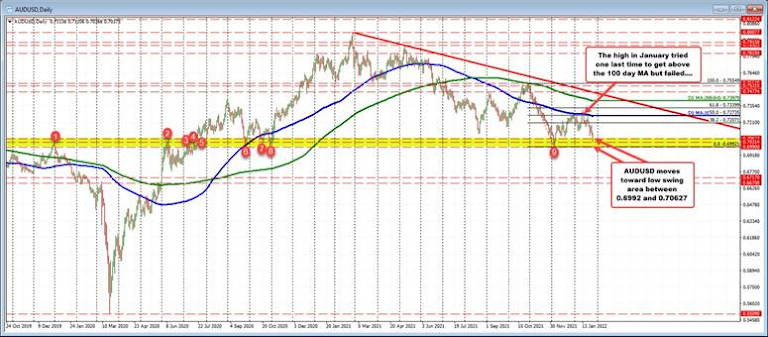
Looking at the daily chart, the pair has entered into a swing area between 0.6992 and 0.70627. That area goes back to the end of 2019. In early November 2020, the pair bottomed one last time in that area before moving higher (peaking in February of 2021) at 0.75544.


Since that cycle high, the pair has steadily moved back down, ultimately retesting the 2019/2020 swing area in December 2021. The subsequent bounce higher saw the 100 hour MA stall the rise in early January 2022. On January 13, a try above the 100 day MA failed. The price retested the level last week, but again found sellers. Buyers turned to sellers again. The 100 day MA currently come in at 07264.

Drilling to the 4-hour chart below, the pair has most recently moved away from a lower swing area between 0.7080 to 0.7090 (see green numbered circles on the chart below). That area is now close risk. Stay below keeps the sellers more in control with the low target from the daily at 0.6992 (the low in December reached 0.69935 before bouncing), the next key target. Move below it, and the door opens more to the downside.

 FOREX ADVICE CLUB: Forex advice club  have the fastest team of FX analysts anywhere. Instantly knowing what headlines and levels matter

Thursday, 27 January 2022

Dollar Rises Like A Ferrari

 LONDON (Reuters) - The dollar climbed to multi-week highs against other major currencies on Thursday, bolstered by the prospects for faster and larger interest rate hikes in the months ahead.

As London trade got under way, the dollar index held at its highest levels since mid-December, while the euro languished at two-month lows of $1.11930. The greenback also hit its highest levels in more than a year against the New Zealand dollar and a seven-week peak against Australia's currency.

It rose broadly against emerging market currencies as money markets moved swiftly to all but price in as many as five Federal Reserve rate rises this year.

The Fed concluded a two-day meeting on Wednesday and Fed chief Jerome Powell said the central bank was in a mind to begin hiking in March to tame inflation.

He stressed that no decisions had been taken, but answering a question about whether the central bank would consider a 50-basis point hike, he replied without ruling it out.

He said instead that the economy seemed stronger than in the most recent hiking cycle and inflation, much hotter with room to raise rates without "threatening" the labour market.

U.S. gross domestic product figures later on Thursday are expected to show annual growth at its strongest since 1984.

"While the market had already been priced for hikes, a lot of people were assuming that the Fed might be more sensitive to the equity market, which it wasn't," said Jane Foley, head currency strategist at Rabobank. "Also the Fed's mention the balance sheet has focused markets' mind on the withdrawal of stimulus."

Foley added that a shake-out of overly long dollar positions earlier in the month had left the greenback in a position to react to the latest Fed signalling.

Forex Advice Club hitted the fastest newa coollector on internet where as the best signal provider 

YUAN HIT

The dollar's overnight leap of 0.7% against the yen was its sharpest in more than two months, while Treasury yields shot higher and stock markets took a fresh beating as rate-hike prospects resonated.

The dollar index was last at 96.825, holding near its highest levels since mid-December.

The risk-sensitive Australian dollar was last down about 0.5% at $0.7077, having fallen to as low as $0.7064, while the New Zealand dollar fell 0.7% to $0.6597, a nearly 15-month trough.

Sterling fell to a one-month low at $1.3407 and was last down 0.4% on the day. Britain's pound is delicately balanced as traders keep a wary eye on Prime Minister Boris Johnson, who is under pressure after attending parties during lockdowns, and on next week's Bank of England meeting. [GBP/]

Elsewhere, China's yuan took a hit as data showed Chinese industrial profits grew at their slowest pace in more than 18 months, bolstering the case for policy support.

The yuan was on course for its steepest daily drop in more than a month in onshore trade and last traded at 6.3632 to the dollar. Emerging markets currencies across Asia also logged losses.[CNY/][EMRG/FRX]

After a battering last week, cryptocurrencies have mostly held their ground in the wake of the Fed's meeting, though bitcoin was last down 2% at $36,049.

Monday, 24 January 2022

Dollar got high today

LONDON/HONG KONG (Reuters) -The dollar inched higher on Monday, moving further off its recent two-month lows, lifted by the tension between Russia and the West over Ukraine and the possibility of a more hawkish stance from the Federal Reserve this week.

Markets were until recently not fretting about the massing of Russian troops on Ukraine's borders, but tensions have tightened several notches of late, with U.S. President Joe Biden considering boosting military assets in Eastern Europe and ordering diplomats' families to leave Kyiv.

We know the volitality of Market For best trading experience Forex Advice Club is the right place.


ING Bank strategist Francesco Pesole said markets were pricing more of a risk premium into the euro, with fears worsening that Russia's standoff with the West could prompt it to curb energy supplies to Europe.

Meanwhile, the IHS Markit Flash Composite Purchasing Managers' Index for the euro zone, a gauge of economic health, dropped in January to its lowest since last February.

The euro slipped 0.15% by 0845 GMT to $1.1325, trading just off two-week lows touched on Friday, while the dollar index was 0.10% higher at 95.72.

The greenback also gained 0.1% on the safe-haven yen with a dollar worth 113.8 yen, though the Japanese currency was still near its recent top of 113.47.

The dollar index has gained some 1.3% off since Jan. 14. During this period, several banks have upped forecasts for the speed and size of policy tightening by the U.S. Federal Reserve.

The Fed starts a two-day meeting on Tuesday and may signal the start of interest rate rises from March while indicating how fast it will move with reducing the size of its balance sheet.

Most expect the first hike to 0.25% in March and three more to 1.0% by year end..

However, positioning data showed on Friday speculators cut net long positioning on the dollar to the lowest since September and instead added $2.6 billion worth of net positions.

ING's Pesole said leaving aside the Ukraine situation, the dollar recovery could stall if the Fed signalled an implicit preference for balance sheet reduction as a means to tighten policy.

"If markets see the Fed willing to let balance sheet reduction do the heavy lifting, that may force a scaleback in forecasts for the number of rate hikes," he said.

"The dollar will find more support from actual rate hike expectations than expectations of draining liquidity out of the market."

The Australian dollar meanwhile slipped 0.25% to two-week lows of A$0.71.52 against the greenback, ahead of Tuesday data that may show core inflation at 2.4%, the fastest rate of price growth since 2014..

The one currency to hold firm against the dollar was the Chinese yuan, which rose 0.2% to the highest since May 2018 at 6.328

Finally, Bitcoin which has almost halved in value since touching a $69,000 record in November, looked at risk of falling under $34,000 for the first time since last July.

It lost 3.6% to trade around $34,962, while ether, the world's second-largest cryptocurrency, was at $2,379, having hit its lowest since July on Saturday

For best Signals Forex Advice Club .


Remarketing tags may not be associated with personally identifiable information or placed on pages related to sensitive categories. See more information and instructions on how to setup the tag on: http://google.com/ads/remarketingsetup --------------------------------------------------->