Showing posts with label best comex signals. Show all posts

Thursday, 21 April 2022

Gold Price Forecast: XAUUSD to see a fresh bull trend only above the $2,070/75 highs – Credit Suisse


Gold maintains a slight upward bias in its broader sideways range. A break past the $2,070/75 highs would resolve the range higher for a fresh bull trend, strategists at Credit Suisse report.

Break below $1,877 to reassert the broad sideways range

“Gold above $1,877 can maintain an immediate upward bias in the broader sideways range.”

“Only above the $2,070/75 highs though would be seen to resolve the range higher for a fresh bull trend, with resistance then seen at $2,280/2,300.”

“A break below $1,877 can further reassert the broad sideways range with support then seen next at $1,845/31.”

Wednesday, 6 April 2022

At 24h tonight, the Fed will publish the minutes of the FOMC's monetary policy meeting


At 24h tonight, the Fed will publish the minutes of the FOMC's monetary policy meeting.  Federal Reserve Chairman Jerome Powell previously said that the Fed will set a limit on its balance sheet cuts at its March meeting. Additionally, Fed chief Brainard said the Fed could quickly shrink the board.  balance sheet since May, and it is expected that the shrinking pace of the balance sheet will be much faster than the previous recovery. Therefore, expect the minutes of tonight's monetary policy meeting.  basically digested.  Market focus remains on Ukraine and Russia situation and inflation expectations.  According to NBC News, the US and G7 will announce new sanctions against Russia on Wednesday.  New US sanctions against Russia will include a ban on new investments in Russia, increased sanctions on Russian financial institutions and state-owned enterprises, and measures  sanctions against Russian government officials and their family members

Friday, 11 March 2022

After falling to 1970 precious metal Gold has shown signs of recovering back to around 2009, closing yesterday's session around 1996.After falling to 1970 precious metal Gold has shown signs of recovering back to around 2009, closing yesterday's session around 1996.


 ðŸ“• Comment on Gold on 11/03/2022:


 - After falling to 1970 precious metal Gold has shown signs of recovering back to around 2009, closing yesterday's session around 1996. This shows that the downward pressure of Gold shows signs of slowing down.  In addition to the current developments and news, there is still no sign of any signs of the war cooling down, de-escalating as the Russian army continues to move towards the capital Kyiv and open more.  attacks on major cities of Ukraine.  In my personal opinion, the possibility of Gold will still be pushed up in today's trading session.

 - On the h4 time frame we can see the closest support for this precious metal is around the 1973-1982 range.  Here, investors can establish a buy position with a safe target around the 2008-2015 threshold.

Thursday, 3 March 2022

Russian rouble falls to record lows after ratings downgrades


The Russian rouble slid further on Thursday, hitting record lows against the dollar and euro, after ratings agencies Fitch and Moody's (NYSE:MCO) downgraded Russia's sovereign debt to "junk" status citing the impact of Western sanctions.

At 0830 GMT, the rouble was more than 10% weaker against the dollar at 117.5 and had lost over 7% against the euro to trade at 124.1 on the Moscow Exchange, marking the first time the rouble has traded above 110 to the dollar in Moscow.

The Russian central bank imposed a 30% commission on foreign currency purchases by individuals on currency exchanges - a move brokers said appeared designed to curb demand for dollars - but that did little to halt the rouble's slide.

Russia's financial markets have been thrown into turmoil by sanctions imposed over its invasion of Ukraine, the biggest attack on a European state since World War Two.

Russia calls its actions in Ukraine a "special operation" that it says is not designed to occupy territory but to destroy its southern neighbour's military capabilities and capture what it regards as dangerous nationalists.

Since Russian troops entered Ukraine on Feb. 24 the rouble is down close to 30% against the dollar, and analysts said on Thursday it would probably remain highly volatile. The government has ordered Russian exporters to convert 80% of their forex revenues into roubles to support the local currency, but people are still queuing up at banks to buy dollars as the rouble slumps.

Trading on the Moscow Exchange's stock section remained largely closed on Thursday, a fourth day of restrictions ordered by the central bank.

Overnight, Fitch said that U.S. and European Union sanctions prohibiting any transactions with the Bank of Russia would have a "much larger impact on Russia's credit fundamentals than any previous sanctions". Moody's said the severity of the sanctions "have gone beyond Moody's initial expectations and will have material credit implications".

S&P lowered Russia's rating to sub-investment grade last week.

Russia's invasion of Ukraine and the sanctions imposed in response have led to dire warnings about the Russian economy, with the Institute of International Finance predicting a double-digit contraction in growth this year.

On Wednesday, index providers FTSE Russell and MSCI said they would remove Russian equities from all their indexes, after a top MSCI executive earlier this week called Russia's stock market "uninvestable".

Monday, 28 February 2022

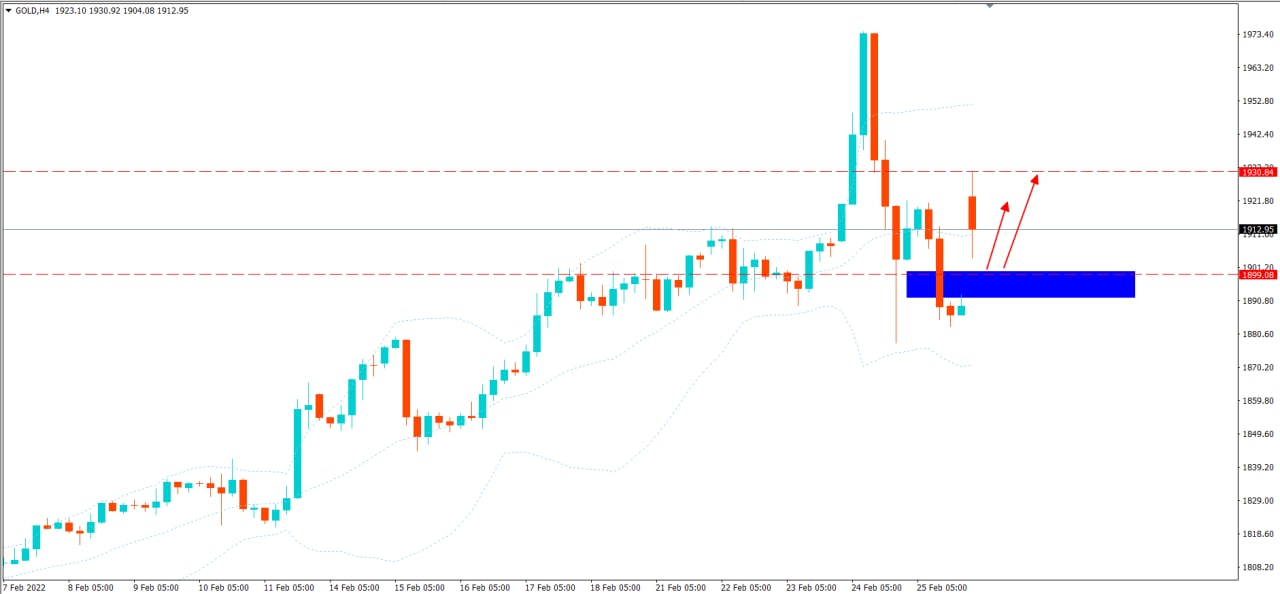
Comment on Gold on February 28, 2022:


 Last week, we saw very strong fluctuations, Gold price bounced up quickly to 1974 and then fell sharply to 1877, closing the session with a bearish candle around 1889. At the beginning of the session.  this morning's trading World gold opened the first session of the week with about GAP increasing to nearly 1930 at the opening session and then decreasing after that.  With the Russian military campaign in Ukraine along with the tension of the US and its allies, it is very difficult at this time for Gold to fall deeply, so in my opinion, the possibility of Gold will continue to gain momentum.  get a raise.

for best recommendations FOREX ADVICE CLUB

On the H4 time frame, Gold is showing signs of completing the GAP and if Gold returns to around 1900, this is the price range we can consider buying in with this precious metal with a target of 193x.  Another note is that currently, the amplitude of Gold at this time will be quite large, so everyone balances the volume and capital for safer transactions.

Saturday, 26 February 2022

Dollar retreats as risk appetite returns; U.S. inflation dials back Fed view

 MEW YORK (Reuters) - The U.S. dollar dipped on Friday, giving back some of the strong gains from the previous day, as investors gauged the latest round of sanctions on Russia and U.S. inflation data was seen as unlikely to make the Federal Reserve overly aggressive at its next policy meeting.


The greenback on Thursday notched its biggest one-day percentage gain since Nov. 10 to reach 97.74, its highest since June 30, 2020. However, it gave back some gains after U.S. President Joe Biden hit Russia with a wave of sanctions following that country's invasion of Ukraine, but refrained from imposing sanctions on Russian President Vladimir Putin and disconnecting Russia from the SWIFT international banking system.

U.S. economic data showed consumer spending increased more than expected in January even as price pressures mounted, with annual inflation hitting rates last seen four decades ago, although the personal consumption expenditures price index increased 0.6% in January after rising 0.5% in December.

"The revisions to income and spending data shows the economy was very resilient to Omicron and to high oil prices. Hopefully, the situation with Russia is short-lived, but even if oil prices stay elevated, the economy should have enough fundamental strength to tolerate high energy prices," said Brian Jacobsen, senior investment strategist at Allspring Global Investments in Menomonee Falls, Wisconsin.

"The inflation numbers weren’t great, but at least the month-on-month inflation numbers aren’t moving higher," Jacobsen said. "That should take some wind out from under the wings of the most hawkish Fed members."

The dollar index fell 0.459%, with the euro up 0.59% to $1.1257. The euro fell to $1.105 on Thursday, its weakest against the greenback since June 1, 2020.

Even with Friday's pullback, the dollar was still on track for a third straight week of gains.

The increased risk appetite was evident in the U.S. stock market, with the S&P 500 up more than 2% after staging a late session rally on Thursday.

Before Thursday's jump -- which sent the dollar to its highest level since June 30, 2020 -- the greenback had been subdued in recent weeks, as rising tensions in Ukraine fueled expectations the Fed may be less aggressive in tightening policy as it attempts to rein in inflation.

Expectations for at least a 50-basis-point interest rate hike at its March meeting have fallen to 25% from around 34% a day ago, according to CME's FedWatch Tool.

In the central bank's latest monetary policy report to Congress, the Fed warned inflation could last longer than anticipated should labor shortages and fast-rising wages continue.

The European Union is planning a third round of sanctions against Moscow, an EU official said on Friday, minutes after Ukraine's president pleaded with the bloc for faster, more forceful steps to punish Russia for its invasion of his country.

Policymakers at the European Central Bank (ECB) said the situation in Ukraine could cause the ECB to slow its exit from stimulus measures.

Investors see only a 4% chance the ECB will boost its benchmark interest rate by 10 basis points at its March 10 policy meeting. [IRPR]

The Russian rouble strengthened 1.67% versus the greenback to 83.04 per dollar after hitting hit a record low of 89.986 the day before.

The Japanese yen weakened 0.09% versus the greenback at 115.65 per dollar, while Sterling was last trading at $1.34, up 0.19% on the day.

In cryptocurrencies, bitcoin last rose 1.4% to $38,937.21.

Ethereum last rose 2.58% to $2,703.53.


Friday, 25 February 2022

Russia's rouble also recovered some ground, trading at around 82.8 per dollar

 The euro steadied on Friday following Thursday's sharp declines after Russia's all-out invasion of Ukraine unleashed the biggest attack on an European state since World War Too.

The dollar flattened against most currencies as markets walked back some of the tumultuous moves from the previous day.


Russia's rouble also recovered some ground, trading at around 82.8 per dollar, having hit a record low of 89.986 per dollar the day before.

"FX markets are slightly calmer this morning as the world tries to come to terms with war in Europe," said Chris Turner

Global Head of Markets at ING.

The size and prominence of the sanctions on Russian banks and the size of their FX deposits may take some time to percolate through, he said.

The United States, the European Union and some other countries responded to Russia's invasion of Ukraine with a wave of sanctions impeding Russia's ability to do business in major currencies along with sanctions against banks and state-owned enterprises.

Fighting continued on Friday though risk sentiment across markets improved after the shock in the previous 24 hours, with the pan European stocks index bouncing back around 1%. [MKTS/GLOB]

The euro was last at $1.1175, edging 0.15% lower against the dollar, having touched its lowest $1.1106 since May 2020 on Thursday.

Sterling also recovered some ground from Thursday's tumble to trade flat against the dollar at $1.3389, having hit a 2022 low of $1.3272 on Thursday.

For free tips FOREX ADVISE CLUB

The safe-haven dollar index steadied against a basket of currency at 97.162 after climbing to its highest level since June 2020 the previous day.

As well as the direct fallout of the war in Ukraine, currency traders were trying to assess its impact on monetary policy around the world.

Policymakers at the European Central Bank (ECB) said the situation in Ukraine could cause the ECB to slow its exit from stimulus measures.

Meanwhile, investors and some U.S. officials said the war would likely slow but not stop approaching interest rate hikes.

Federal Reserve policymakers have been publicly sparring over whether to begin with a 25 or 50 basis point rate hike at its March meeting.

"We expect the consequences (of the conflict) to translate into a somewhat less hawkish stance from major central banks – tilting the Fed towards a 25 basis hike in March and keeping the ECB on the fence," said Invesco strategists in emailed comments.


Thursday, 24 February 2022

rouble bonds over accusations of Moscow meddling in the U.S. election.

  - Western capitals have started putting in place fresh restrictions on Russia's sovereign debt as they seek to ratchet up pressure on Moscow over the conflict with Ukraine.

The United States and its allies introduced an initial round of sanctions after Russian President Vladimir Putin recognised two breakaway regions in eastern Ukraine on Monday. A string of harsher measures is expected after he launched a full-scale invasion on Thursday.


as the crises occurs the market you are looking for is not variable and some variations occurs for that to make your trading experience better FOREX ADVICE CLUB is havin all the knowledge to provide the best profits to you .

Access to Russian bonds had become increasingly restricted. U.S. sanctions imposed following the 2014 annexation of Crimea made future Russian dollar-denominated debt ineligible for many investors and key indexes.

In April 2021, U.S. President Joe Biden barred U.S. investors from buying new Russian rouble bonds over accusations of Moscow meddling in the U.S. election.

Here is an overview of what measures have already been added and what impact they might have:

WHAT ARE THE NEW RESTRICTIONS ON SOVEREIGN DEBT?

Washington announced a ban on U.S. entities participating in secondary markets for both rouble and non-rouble debt issued by Russia's central bank, the national wealth fund and the finance ministry after March 1.

The European Union agreed new sanctions that will target the ability of Moscow to access the bloc's capital and financial markets as well as services, and ban EU investors from trading in Russian state bonds. Canada's government said it would bar its citizens from engaging in purchases of Russia's sovereign debt.

Britain said on Wednesday it would stop Russia selling sovereign debt in London - one of the world's major financial centres for such transactions. The measures would require additional legislation, according to Western officials, and clearing transactions would also be affected. However, there was no indication on whether Britain would stop trade in outstanding sovereign debt.

The coordinated measures are aiming to curb Russia's ability to raise new foreign financing and plug some loopholes. Despite the limitations in the United States, Russia had been able to issue bonds in European markets.

Analysts at JPMorgan (NYSE:JPM) calculate that Russia has issued a combined 3.5 billion in euro-denominated bonds since 2020.

IMPLICATIONS FOR INVESTORS

Analysts see limited implications for holders of existing hard-currency bonds.

They, however, predicted the new U.S. sanctions on local sovereign bonds, so-called OFZs, would lead to the creation of two different classes of OFZs.

In response to the U.S. curbs on local sovereign bonds, the finance ministry said it would offer only new series of OFZs starting from Feb. 22 and stop tapping issues registered before this date "to lower risks of forced selling of circulating state securities by particular categories of foreign investors."

JPMorgan said that bonds which had been sold since mid-June had a 10-25 bps premium over existing issues, though this divergence faded, likely due to bonds being added to the most widely used emerging fixed income benchmark.

"However, premia may be more persistent this time given that new OFZs will not be index eligible," said Nicolaie Alexandru-Chidesciuc at JPMorgan. "As long as local banks can freely transact with foreigners the basis between the two curves should remain relatively narrow (within 20-30bp)."

WHAT DOES THIS MEAN FOR CAPITAL FLOWS?

Latest data shows that Russia has just under $40 billion in dollar and euro-denominated bonds outstanding, with just over half held by foreign investors. Positioning in those bonds by foreign investors looked light and the most underweight in two decades, according to a JPMorgan emerging market client survey.

Meanwhile foreign investors held around 18% or 2.8 trillion roubles ($34.4 billion) of overall outstanding OFZs, according to ING.

The new U.S. sanctions are not expected to trigger forced selling in OFZs. However, capital flows have shown investors ditched the bonds as tensions over Ukraine have escalated since late last year.

"Russia is now experiencing the fifth consecutive month of foreign portfolio outflows from OFZ," said Chris Turner, global head of markets at ING. "In October-January it totalled $5.4 billion, and since the beginning of February, some $1.1 billion were withdrawn."

Russia currently has a weight of 6.8% in JPMorgan's local sovereign debt benchmark, though given the U.S. measures would see no new issues added while existing ones would mature, the weighting was expected to shrink to below 5% in just over three years, the bank projected.

JPMorgan, which runs some of the most widely-used hard and local currency fixed income indexes in emerging markets, said on Wednesday it was reviewing the impact the new U.S. curbs may have on its emerging market benchmarks.

($1 = 81.3255 roubles)

Wednesday, 23 February 2022

Series on Russia-Ukraine Tensions:


 On Wednesday, Prime Minister Fumio Kishida said Japan is imposing sanctions on Russia over its actions in Ukraine, and considers Moscow's moves an unacceptable violation of  with Ukraine's sovereignty and international law.


FOREX ADVICE CLUB is having a team of 99+ members in klse,us stocks,gold & crypto also providing free trials for the people you can learn and earn both can do on same time & platform.


 Japan's sanctions include banning the issuance of Russian bonds in Japan and freezing the assets of certain Russian individuals as well as restricting travel to Japan, Kishida said.


 Western nations on Tuesday imposed new sanctions on Russian banks and elites after Moscow sent troops into breakaway regions in eastern Ukraine

Thursday, 17 February 2022

EURO DOWNS AND SOLD AS WATER

 tterjee

LONDON (Reuters) - The U.S. dollar treaded water on Thursday and the Japanese yen held on to its earlier gains after a Russian news report of mortar fire in eastern Ukraine jangled market nerves and boosted the appeal of safe haven bets.

Russia-backed rebels accused Ukrainian forces of shelling their territory in violation of agreements aimed at ending conflict in the contested Donbass area, the RIA news agency said, a report later denied by Ukraine.

While the greenback retreated from its Asian highs after the news broke, investors remained wary that Russia will invade the Ukraine again despite rising optimism at the start of this week that a diplomatic solution would be found to prevent conflict.

Against a basket of its rivals, the dollar steadied at 95.747 after rising above 96 in early Asian trading.

But in a sign that markets were not panicking yet, the rouble remained below a November 2020 high of 80 hit last month, while bond yields were only modestly higher.

"This strongly suggests that market participants remain optimistic overall that conflict will be avoided," MUFG strategists said in a client note.


FOREX ADVICE CLUB having fastest team on forex,comex,klse,and us stocks and provide free signals support & counters.


The geopolitical news dwarfed the Fed's minutes of its January meeting, where policymakers agreed that it was time to tighten monetary policy but also that decisions would depend on a meeting-by-meeting analysis of data, according to minutes of the most recent policy meeting.

Short-dated U.S. Treasury yields fell and the yield curve steepened after the minutes as traders reassessed the probability of a 50 bps hike at the Fed's March meeting. Money markets were pricing in a 72% likelihood of a 50 bps hike next month compared to 80% at the start of the week.

The euro rebounded from earlier lows after falling as much as 0.4% after the Ukraine news. But Ukraine's denial and the location of the reported attack within already contested territory calmed things and the euro last sat at $1.1382.

The yen and the Swiss franc clung on to earlier gains, up 0.2% and 0.1% respectively versus the greenback.

Wednesday, 16 February 2022

EURO POUNDS HIGH ON FRIDAY

 LONDON (Reuters) -Oil prices recouped losses on Wednesday as investors weighed conflicting statements on the possible withdrawal of some Russian troops from around Ukraine amid tight global supplies and recovering fuel demand.

Brent traded at $93.86 a barrel around 1000 GMT, up 62 cents, or 0.6%, having slid 3.3% overnight after Russia announced a partial pullback of its troops near Ukraine.

U.S. West Texas Intermediate (WTI) crude was at $92.64 a barrel, up 62 cents, or 0.6%, after the contract ended Tuesday's session down 3.6%.

FOREX ADVICE CLUB is providing free trials and best known as the fastest team of forex, comex, klse,us stocks

Both benchmarks hit their highest since September 2014 on Monday, with Brent touching $96.78 and WTI reaching $95.82.


The price of Brent jumped 50% in 2021, while WTI soared about 60%, as a global recovery in demand from the COVID-19 pandemic strained supply.


Moscow announced a partial pullback of troops from Ukraine's borders, but NATO Secretary-General Jens Stoltenberg said on Wednesday the alliance had not seen any de-escalation, but rather that Russia was continuing its military build-up.


"The risk of a full scale invasion has receded a bit. But we are unlikely to move out of the current status quo," said Bjarne Schieldrop, chief commodities analyst at SEB in Oslo.


Beyond Ukraine tensions, the oil market remains tight and prices could still be on course for a move towards $100 a barrel.


"The price action has been an incredibly bullish one-way-street higher since just before Christmas. You don't see this kind of price action unless the market is very tight," Schieldrop added.


Investors await weekly U.S. oil inventories data from the Energy Information Administration due at 10:30 a.m. (1530 GMT).


U.S. crude and distillates inventories may have fallen by 1.5 million to 1.6 million barrels last week, a Reuters poll showed. [EIA/S]


Data from the American Petroleum Institute showed a drop in crude, gasoline and distillate stocks last week, according to market sources on Tuesday. [API/S]


(Additioanl reporting by Chen Aizhu and Florence TanEditing by Clarence Fernandez and Mark Potter

Tuesday, 15 February 2022

REBOUND OF EURO

 LONDON (Reuters) - The euro rebounded on Tuesday, nearly erasing all of Monday's losses, after reports that some Russian troops in areas near Ukraine have started returning to their bases.

Against the greenback, the single currency climbed 0.4% to $1.1346, and within striking distance of Monday's high of $1.1369 as European stock futures rebounded on the news.

Some troops in Russia's military districts adjacent to Ukraine are returning to bases after completing drills, Russia's defence ministry was quoted as saying, a move that could de-escalate frictions between Moscow and the West.


FOREX ADVICE CLUB have the fastest team of forex,comex,gold,crypto and Us stocks also they are providing free trials 

"While any news about a potential de-escalation is welcome, I think the markets will want to see something more concrete before judging the crisis to be over," said Stuart Cole, head macro economist at Equiti Capital.

"By this I think it will require the removal from the border of sufficient troop numbers or military hardware that makes an invasion materially more difficult to undertake,"

Brewing geopolitical tensions had kept a lid on the euro's gains in recent days even as the European Central Bank joined its central bank peers in signaling a hawkish turn in its monetary policy at a meeting this month.

The euro tumbled to a near two-week low on Monday after Ukrainian President Volodymyr Zelenskiy called on citizens to fly the country's flags from buildings and sing the national anthem in unison on Feb. 16, a date that some Western media have cited as a possible start of a Russian invasion.

For now, investors greeted the news with relief, pushing up the currencies of economies that would be most affected by the conflict including the pound, euro and the Russian rouble while typical safe-haven shelters like the yen and the Swiss franc weakened.

Away from geopolitics, U.S. Federal Reserve officials continuing to spar over how aggressively to begin upcoming interest rate increases at their March meeting.

But the dollar failed to get a fresh lift from the comments with an index weakening 0.3% versus its rivals.

In cryptocurrencies, bitcoin was 3.4% higher, trading around $44,000.

Monday, 14 February 2022


(Reuters) -The dollar rose on Monday along with the yen and Swiss franc as investors rushed into safe-haven assets on fears that Russia is preparing to invade Ukraine.

Russia could make such a move at any time and might create a surprise pretext for an attack, according to the United States, which reaffirmed on Sunday a pledge to defend "every inch" The dollar index rose 0.4% to 96.328, its highest since Feb. 1.

of NATO territory. Moscow denied any such plans and has accused the West of 

FOREX ADVICE CLUB is the fastest team of forex,comex,gold or klse they having9+ years of experience

Euro-dollar one-month implied volatility was at 7.6%, from below 6% at the end of January.

The rouble was 0.1% lower at 77.20 against the dollar, after tumbling to its lowest since January 28 on Friday as investors ditched Russian assets.

Commerzbank (DE:CBKG) analysts pointed out that “European dependency on Russian energy makes the cyclical economic performance of the euro zone particularly vulnerable in case of an escalation of the conflict in Ukraine.”

The euro was down 0.3% at $1.1318, after hitting its lowest level since Feb. 3 at $1.1305.

The euro weakened on Friday when a rush into safe-haven assets overshadowed expectations for monetary policy tightening from the European Central Bank.

ECB president Christine Lagarde had also dampened some of the bullish euro sentiment by reiterating that any policy action will be gradual.

The U.S. Federal Reserve will release its January meeting minutes on Wednesday, but analysts said central bank action was unlikely to return to the spotlight until the risk of an escalation over Ukraine recedes.

A rush into safe-haven assets has propped up the Japanese yen since Friday, while the Bank of Japan successfully defended its key bond yield target on Monday, holding the line on its ultra-loose monetary policy.

The yen rose 0.3% to 115.16 against the dollar, and 0.5% against the euro.

“These two currencies (the U.S. dollar and the yen) – as well as the Swiss franc – should remain bid until, and if, we get indications that a diplomatic solution is in sight,” ING analysts said, adding that “markets are adopting a wait-and-see approach on geopolitics at the start of the new week.”

We “flag quite significant downside risks for exposed currencies - directly the rouble and indirectly all pro-cyclical currencies and especially the European ones - should tension escalate further,” ING said.

The Swiss franc rose 0.4% against the euro to 1.0452, its highest since Feb. 3.

In cryptocurrencies, bitcoin was down 1% at around $42,116.

Wednesday, 9 February 2022

Dollar is Lower; Tight Range Ahead of Inflaton

 The U.S. dollar edged lower Wednesday, but remained in a tight range the day before the release of key inflation data which could confirm the start of the Federal Reserve’s policy tightening process. 

At 2:55 AM ET (0755 GMT), the Dollar Index, which tracks the greenback against a basket of six other currencies, traded 0.1% lower at 95.580, after bouncing off a 2-1/2-week low of 95.136 reached Friday. 


 FOREX ADVICE CLUB HAVE THE BEST RESEARCH TEAM AND THEY ARE PROVIDING FREE TRIALS IN GOLD,CURRENCIES,CRYPTOS .


The speed and timing of when central banks across the world start to lift interest rates is the main factor driving the foreign exchange markets these days, and in particular the Federal Reserve given the importance of the U.S. economy to global growth.

The dollar received a boost at the end of last week with the release of a much stronger than expected jobs report, and Thursday’s consumer price index should cement expectations that the U.S. central bank will raise interest rates next month.

The headline CPI is seen rising 0.5% on the month and 7.3% on the year in January, climbing to a four-decade high. Most in the market expected the Fed to lift interest rates by 25 basis points in March, a stronger print could offer support to those tipping a larger 50 basis point rise.

“We think that Friday’s payrolls numbers have helped build a floor under the dollar as markets should continue to cement their hawkish views on Fed tightening into the March meeting,” said analysts at ING, in a note.

Elsewhere, EUR/USD edged lower to 1.1412, retreating from the highs seen last week after the European Central Bank policy meeting, as President Christine Lagarde tried Monday to rein in these expectations for aggressive action with growth in the Eurozone still fragile.

“We still think that the market pricing of more than 50bp of higher overnight rates, i.e. around two 25bp rate hikes, until the end of the year looks excessive,” said analysts at Nordea, in a note.

Additionally, GBP/USD edged lower to 1.3538, USD/JPY fell 0.1% to 115.45, after the pair briefly touched a one-month high, while the risk-sensitive AUD/USD climbed 0.1% to 0.7148.

USD/PLN rose 0.1% to 3.9652 and EUR/PLN was flat at 4.5240, the day after Poland’s central bank lifted its benchmark rate by 50 basis points to 2.75%, increasing interest rates for a fifth consecutive month to an almost nine-year high in an attempt to curb record inflation levels.

Later Wednesday, the Riksbank holds its latest policy-setting meeting, with the markets increasingly looking at still-dovish central banks given the recent shift in many of their peers.

“The Swedish economy has overall developed better than projected by the Riksbank,” said Nordea, and “the development is strong enough for the Riksbank to trim its balance sheet.”

“However, we do not expect inflation to remain high long enough for the Riksbank to consider a rate hike.”

EUR/SEK traded 0.1% lower at 10.4226 and USD/SEK also down 0.1% at 9.1358.

Remarketing tags may not be associated with personally identifiable information or placed on pages related to sensitive categories. See more information and instructions on how to setup the tag on: http://google.com/ads/remarketingsetup --------------------------------------------------->