Showing posts with label best forex signal provider. Show all posts

Monday, 2 May 2022

US Dollar Index Price Analysis: Room for a test of YTD highs


  • DXY resumes the upside beyond the 103.00 yardstick.
  • Next on the upside comes the cycle tops near 104.00.

The index leaves behind the pullback seen at the end of last week and advances above the 103.00 area on Monday.

Price action in DXY remains supportive of the resumption of the uptrend with the initial target at the 2022 highs just below the 104.00 yardstick (April 28). Above this level comes 105.63 (December 11 2002 high).

The current bullish stance in the index remains supported by the 8-month line near 96.80, while the longer-term outlook for the dollar is seen constructive while above the 200-day SMA at 95.56

Thursday, 21 April 2022

Gold Price Forecast: XAUUSD to see a fresh bull trend only above the $2,070/75 highs – Credit Suisse


Gold maintains a slight upward bias in its broader sideways range. A break past the $2,070/75 highs would resolve the range higher for a fresh bull trend, strategists at Credit Suisse report.

Break below $1,877 to reassert the broad sideways range

“Gold above $1,877 can maintain an immediate upward bias in the broader sideways range.”

“Only above the $2,070/75 highs though would be seen to resolve the range higher for a fresh bull trend, with resistance then seen at $2,280/2,300.”

“A break below $1,877 can further reassert the broad sideways range with support then seen next at $1,845/31.”

Monday, 11 April 2022

EUR/USD: A test of the March 7 low near 1.0805 is still in the cards – BBH


 The euro bounced after the French election but remains heavy near 1.09. Economists at BBH note that the EUR/USD pair may test the March 7 low near 1.0805.

Run-off will be held between Macron and Le Pen

“Macron got 28% of the vote vs. 24% for Le Pen in the first round. One early poll shows Macron winning 54-46% in the second round, while another one is a lot closer at 51-49%. We warn of the so-called Bradley effect, which suggests that the polls will likely understate Le Pen’s support. If polls tighten up ahead of the runoff, we expect markets to become more jittery.”

“A break above 1.1050 is needed to signal a deeper correction towards the March 31 high near 1.1185.” 

“A test of the March 7 low near 1.0805 is still in the cards.”

Tuesday, 29 March 2022

Singapore: Industrial Production remains robust – UOB

 Economist at UOB Group Barnabas Gan reviews the latest industrial production figures in Singapore.


Key Takeaways

“Industrial production surged 17.6% y/y (+16.6% m/m sa) in Feb 2022, surprising market expectations for a 6.3% y/y (+5.7% m/m sa) growth. Excluding biomedical manufacturing, industrial production rose 16.8% y/y.”

“The strong performance in Singapore’s manufacturing sector is underpinned by the global trade recovery, especially on the back of healthy semiconductor- and biomedical-related demand. Other factors that have supported Singapore’s manufacturing momentum also include the gradual reopening of international borders, which resulted in higher levels of maintenance, repair and overhaul activity from commercial airlines.”

“In all, our outlook is for full-year manufacturing to grow by an average of 4.0% in 2022. This suggests that despite the high-base growth rate seen in 2021, global trade activity is expected to stay buoyant in the new year.”

Monday, 28 March 2022

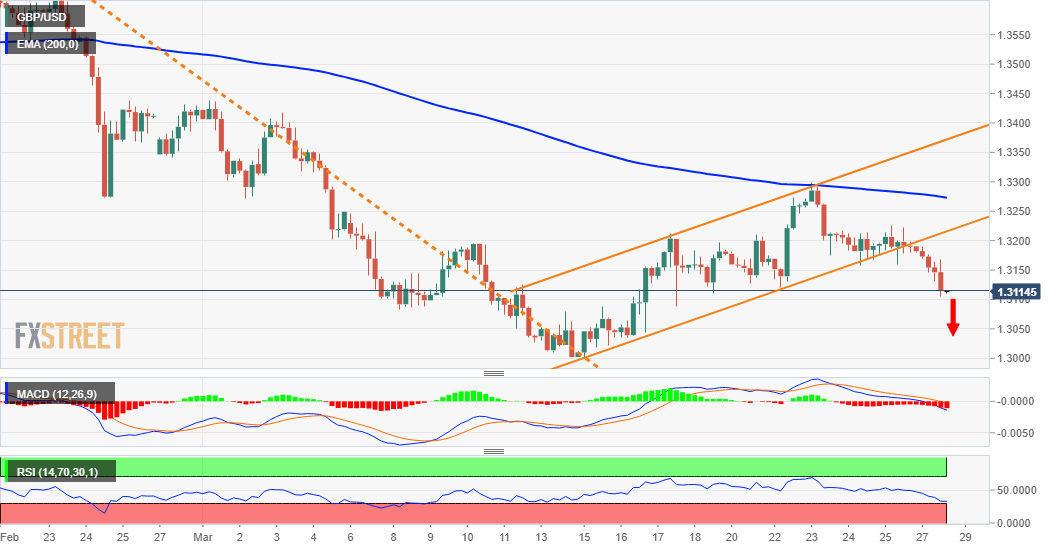
GBP/USD Price Analysis: Seems vulnerable near 1.3100 mark, bearish flag breakdown in play

The GBP/USD pair extended last week's retracement slide from the 1.3300 mark, or the 200-period EMA on the 4-hour chart and witnessed some follow-through selling on Monday. This marked the fourth successive day of a negative move and dragged spot prices to over a one-week low, around the 1.3110 region during the mid-European session.

The US dollar continued drawing support from rising bets for a 50 bps Fed rate hike move at the May meeting. Conversely, the sterling was weighed down by dovish remarks from the Bank of England Governor Andrew Bailey, saying that we are starting to see evidence of a growth slowdown. This, in turn, exerted downward pressure on the GBP/USD pair.

 Looking at the broader picture, the pair on Friday confirmed a break through an ascending trend channel, which constituted the formation of a bearish flag pattern. Sustained weakness below the 1.3100 round-figure mark will further validate the bearish bias and set the stage for a further near-term depreciating move for the GBP/USD pair.

The next relevant support is pegged near the 1.3070 region, below which the downward trajectory could further get extended towards the 1.3035 intermediate support. The GBP/USD pair could eventually drop back to challenge the key 1.3000 psychological mark, or the lowest level since November 2020 touched earlier this month.

On the flip side, attempted recovery moves might now confront stiff resistance near the 1.3150-1.3160 region. Any subsequent move up is more likely to attract fresh selling and remain capped near the 1.3180-1.3185 zone. This is closely followed by the 1.3200 mark, which if cleared decisively might prompt some short-covering around the GBP/USD pair.

GBP/USD 4-hour chart


Saturday, 26 March 2022

XAU/USD Price Forecast: Technical outlook


 Gold (XAU/USD) bias is still up, but it would remain under selling pressure. Failure to reclaim February 24 daily high at $1974 left the precious metal exposed to selling pressure unless XAU bulls recover the aforementioned. It is worth noting that the 200-day moving average (DMA) at $1816.85, from an upslope, is horizontal, indicating that the steep rally above $2000 might be subject to a further correction lower.

Upwards, XAU/USD’s first resistance would be $1974. Once cleared, the next resistance would be $2000, and the YTD high at $2075.82.

On the flip side, and the most likely scenario, XAU/USD’s first support would be March 20 low at $1950.30. Breach of the latter would expose March 16 daily low at $1895.06, followed by November 16, 2021, low at $1877.14.

Friday, 25 March 2022

Euro edges higher as focus on Ukraine, yen rebounds vs dollar

The euro was edging higher on Friday, but concerns about a potential slowdown of the economy kept it in a tight range, while the dollar weakened as investors priced in the expected monetary tightening from the Federal Reserve.

"The combination of lingering Russia-related risks, high energy prices and Fed-ECB policy divergence still points to a weaker, rather than stronger, EUR/USD,” ING analysts said.

"EUR-USD remains quite stuck at around 1.10, with better-than-expected PMI surveys across the eurozone for March not sufficient to induce buying interest,” Unicredit (MI:CRDI) analysts said in a research note.


German business morale deteriorated in March due to worsening supply chain issues resulting from high petrol prices and driver shortages, a survey showed on Friday.

The single currency rose 0.1% to $1.1016

Derek Halpenny, head of global research markets at MUFG, said in a note to clients that some renewed optimism over the prospect of the end of the conflict in Ukraine “helped improve financial market conditions and weaken the U.S. dollar.”

President Volodymyr Zelensky said that Ukrainians "need to achieve peace" and halt Russian bombardment.

The U.S. dollar index, which measures the greenback against six peers, edged 0.1% lower to 98.631

BofA analysts underlined markets priced in next moves from the Fed even before it started and a lot more rapidly than during the previous tightening cycle between 2015 and 2018.

Money markets are betting on 190 bps of Fed rate hikes by year-end, including an 80% chance of a 50 bps in May. [IRPR]

Japan’s yen staged a rebound versus the greenback, up 0.6%, after hitting a fresh low since December 2015 overnight on the difference in rate hike expectations between the Bank of Japan and other major central banks.

Analysts flagged that the Bank of Japan (BOJ) provided a bullish signal as it refrained from stepping into the market Friday morning, even as the 10-year government bond yield rose above the level at which the central bank had offered to buy an unlimited amount in February.

However, Governor Haruhiko Kuroda clarified that a weak yen benefits the economy.

“We don't expect a significant further depreciation of the yen versus the dollar. We think that at 115, it is fairly valued considering the Japanese central bank's dovish stance,” Roman Ziruk, market analyst at Ebury, said.

The Norwegian crown was down 0.2% lower against the euro after rising the previous day as the central bank raised its benchmark interest rate and said it now plans to hike at a faster pace than previously intended.

Get daily live market updates with us. here we are providing best technical and fundamental analysis
with full time support. We also provides learning and recommendation on live trade.

For free trial visit: MONEY LIFE RESEARCH

Thursday, 24 March 2022

AUD/USD to advance back toward 0.75 by year-end – ANZ

 After a tough start to the year, the AUD has rebounded convincingly to become one of the leaders in the G10. Economists at ANZ Bank expect the AUD/USD to move sideways in the near-term before staging a leg higher to the 0.75 level by year-end.

“The terms of trade improvement and a strong domestic economy are likely to keep the AUD well supported, though a challenging risk environment will keep rallies capped.”

“We believe the aussie will be mostly rangebound through the middle part of 2022 before a global growth recovery helps propel a move back to 0.75 by year-end.”

Friday, 11 March 2022

After falling to 1970 precious metal Gold has shown signs of recovering back to around 2009, closing yesterday's session around 1996.After falling to 1970 precious metal Gold has shown signs of recovering back to around 2009, closing yesterday's session around 1996.


 ðŸ“• Comment on Gold on 11/03/2022:


 - After falling to 1970 precious metal Gold has shown signs of recovering back to around 2009, closing yesterday's session around 1996. This shows that the downward pressure of Gold shows signs of slowing down.  In addition to the current developments and news, there is still no sign of any signs of the war cooling down, de-escalating as the Russian army continues to move towards the capital Kyiv and open more.  attacks on major cities of Ukraine.  In my personal opinion, the possibility of Gold will still be pushed up in today's trading session.

 - On the h4 time frame we can see the closest support for this precious metal is around the 1973-1982 range.  Here, investors can establish a buy position with a safe target around the 2008-2015 threshold.

Friday, 4 March 2022

Euro sinks to multi-year lows versus dollar, Swiss franc and sterling


The euro fell to a seven-year low versus the Swiss franc and hit its lowest point in almost two years versus the dollar on Friday as the war in Ukraine lowered expectations of European economic growth.

The European single currency fell 2.1% this week, and was set for its worst week since April 2020.

It was down 0.5% to $1.1010 at 0850 GMT, near its weakest level since May 2020, following news Russian forces seized the largest nuclear power plant in Europe after a building at the complex was set ablaze during fighting with Ukrainian defenders, Ukrainian authorities said on Friday.

Authorities later said the fire in a building identified as a training centre had been extinguished. U.S. Energy Secretary Jennifer Granholm said there were no indication of elevated radiation levels at the plant.

Versus sterling, the euro also hit its weakest level of 82.61 pence since July 2016. It touched its lowest level since January 2015 of 1.0114 against the safe-haven Swiss Franc.

Analyst said the effects of surging energy and gas prices will likely undermine European consumption and economic growth prospects.

"The ECB is going to have no alternative but to look through this surge in inflation but the Fed is not going to delay so we will see more monetary divergence again," said Mike Kelly, head of global multi-asset at PineBridge Investments.

"The dollar should be getting a new spring in its step structurally if things do get worse," Kelly added.

The U.S. dollar index rose 0.36% to 98.073, after touching its highest level since June 2020 against a basket of peers.

While money markets do not expect interest rate hikes at the ECB's next meeting, the U.S. Federal Reserve is all but certain to raise interest rates at its March 15-16 meeting for the first time since the coronavirus pandemic.

Fed Chair Jerome Powell repeated his comments that he would back an initial quarter percentage point increase in the benchmark rate.

In Ukraine, Russian forces were pressing on with surrounding and attacking cities.

Elsewhere, the Australian dollar continued its advance, helped by the commodities boom, and rose 0.6% to a four-month high of $0.7370 versus the U.S. dollar.

High energy prices in turn have prevented the Japanese yen from benefiting as much from the safe haven flows, as Japan is a net importer of energy.

The yen briefly climbed on the dollar when news of the fire emerged, but later gave up those gains and was little changed at 115.37 per dollar.

Thursday, 3 March 2022

Russian rouble falls to record lows after ratings downgrades


The Russian rouble slid further on Thursday, hitting record lows against the dollar and euro, after ratings agencies Fitch and Moody's (NYSE:MCO) downgraded Russia's sovereign debt to "junk" status citing the impact of Western sanctions.

At 0830 GMT, the rouble was more than 10% weaker against the dollar at 117.5 and had lost over 7% against the euro to trade at 124.1 on the Moscow Exchange, marking the first time the rouble has traded above 110 to the dollar in Moscow.

The Russian central bank imposed a 30% commission on foreign currency purchases by individuals on currency exchanges - a move brokers said appeared designed to curb demand for dollars - but that did little to halt the rouble's slide.

Russia's financial markets have been thrown into turmoil by sanctions imposed over its invasion of Ukraine, the biggest attack on a European state since World War Two.

Russia calls its actions in Ukraine a "special operation" that it says is not designed to occupy territory but to destroy its southern neighbour's military capabilities and capture what it regards as dangerous nationalists.

Since Russian troops entered Ukraine on Feb. 24 the rouble is down close to 30% against the dollar, and analysts said on Thursday it would probably remain highly volatile. The government has ordered Russian exporters to convert 80% of their forex revenues into roubles to support the local currency, but people are still queuing up at banks to buy dollars as the rouble slumps.

Trading on the Moscow Exchange's stock section remained largely closed on Thursday, a fourth day of restrictions ordered by the central bank.

Overnight, Fitch said that U.S. and European Union sanctions prohibiting any transactions with the Bank of Russia would have a "much larger impact on Russia's credit fundamentals than any previous sanctions". Moody's said the severity of the sanctions "have gone beyond Moody's initial expectations and will have material credit implications".

S&P lowered Russia's rating to sub-investment grade last week.

Russia's invasion of Ukraine and the sanctions imposed in response have led to dire warnings about the Russian economy, with the Institute of International Finance predicting a double-digit contraction in growth this year.

On Wednesday, index providers FTSE Russell and MSCI said they would remove Russian equities from all their indexes, after a top MSCI executive earlier this week called Russia's stock market "uninvestable".

Monday, 28 February 2022

Comment on Gold on February 28, 2022:


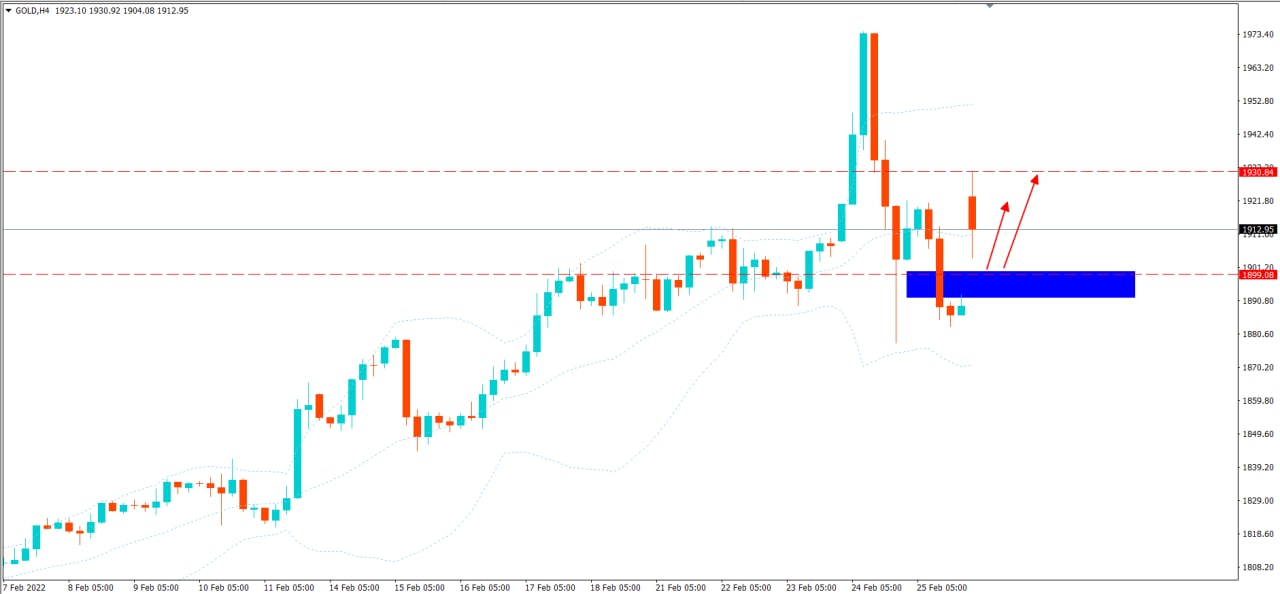
 Last week, we saw very strong fluctuations, Gold price bounced up quickly to 1974 and then fell sharply to 1877, closing the session with a bearish candle around 1889. At the beginning of the session.  this morning's trading World gold opened the first session of the week with about GAP increasing to nearly 1930 at the opening session and then decreasing after that.  With the Russian military campaign in Ukraine along with the tension of the US and its allies, it is very difficult at this time for Gold to fall deeply, so in my opinion, the possibility of Gold will continue to gain momentum.  get a raise.

for best recommendations FOREX ADVICE CLUB

On the H4 time frame, Gold is showing signs of completing the GAP and if Gold returns to around 1900, this is the price range we can consider buying in with this precious metal with a target of 193x.  Another note is that currently, the amplitude of Gold at this time will be quite large, so everyone balances the volume and capital for safer transactions.

Thursday, 24 February 2022

rouble bonds over accusations of Moscow meddling in the U.S. election.

  - Western capitals have started putting in place fresh restrictions on Russia's sovereign debt as they seek to ratchet up pressure on Moscow over the conflict with Ukraine.

The United States and its allies introduced an initial round of sanctions after Russian President Vladimir Putin recognised two breakaway regions in eastern Ukraine on Monday. A string of harsher measures is expected after he launched a full-scale invasion on Thursday.


as the crises occurs the market you are looking for is not variable and some variations occurs for that to make your trading experience better FOREX ADVICE CLUB is havin all the knowledge to provide the best profits to you .

Access to Russian bonds had become increasingly restricted. U.S. sanctions imposed following the 2014 annexation of Crimea made future Russian dollar-denominated debt ineligible for many investors and key indexes.

In April 2021, U.S. President Joe Biden barred U.S. investors from buying new Russian rouble bonds over accusations of Moscow meddling in the U.S. election.

Here is an overview of what measures have already been added and what impact they might have:

WHAT ARE THE NEW RESTRICTIONS ON SOVEREIGN DEBT?

Washington announced a ban on U.S. entities participating in secondary markets for both rouble and non-rouble debt issued by Russia's central bank, the national wealth fund and the finance ministry after March 1.

The European Union agreed new sanctions that will target the ability of Moscow to access the bloc's capital and financial markets as well as services, and ban EU investors from trading in Russian state bonds. Canada's government said it would bar its citizens from engaging in purchases of Russia's sovereign debt.

Britain said on Wednesday it would stop Russia selling sovereign debt in London - one of the world's major financial centres for such transactions. The measures would require additional legislation, according to Western officials, and clearing transactions would also be affected. However, there was no indication on whether Britain would stop trade in outstanding sovereign debt.

The coordinated measures are aiming to curb Russia's ability to raise new foreign financing and plug some loopholes. Despite the limitations in the United States, Russia had been able to issue bonds in European markets.

Analysts at JPMorgan (NYSE:JPM) calculate that Russia has issued a combined 3.5 billion in euro-denominated bonds since 2020.

IMPLICATIONS FOR INVESTORS

Analysts see limited implications for holders of existing hard-currency bonds.

They, however, predicted the new U.S. sanctions on local sovereign bonds, so-called OFZs, would lead to the creation of two different classes of OFZs.

In response to the U.S. curbs on local sovereign bonds, the finance ministry said it would offer only new series of OFZs starting from Feb. 22 and stop tapping issues registered before this date "to lower risks of forced selling of circulating state securities by particular categories of foreign investors."

JPMorgan said that bonds which had been sold since mid-June had a 10-25 bps premium over existing issues, though this divergence faded, likely due to bonds being added to the most widely used emerging fixed income benchmark.

"However, premia may be more persistent this time given that new OFZs will not be index eligible," said Nicolaie Alexandru-Chidesciuc at JPMorgan. "As long as local banks can freely transact with foreigners the basis between the two curves should remain relatively narrow (within 20-30bp)."

WHAT DOES THIS MEAN FOR CAPITAL FLOWS?

Latest data shows that Russia has just under $40 billion in dollar and euro-denominated bonds outstanding, with just over half held by foreign investors. Positioning in those bonds by foreign investors looked light and the most underweight in two decades, according to a JPMorgan emerging market client survey.

Meanwhile foreign investors held around 18% or 2.8 trillion roubles ($34.4 billion) of overall outstanding OFZs, according to ING.

The new U.S. sanctions are not expected to trigger forced selling in OFZs. However, capital flows have shown investors ditched the bonds as tensions over Ukraine have escalated since late last year.

"Russia is now experiencing the fifth consecutive month of foreign portfolio outflows from OFZ," said Chris Turner, global head of markets at ING. "In October-January it totalled $5.4 billion, and since the beginning of February, some $1.1 billion were withdrawn."

Russia currently has a weight of 6.8% in JPMorgan's local sovereign debt benchmark, though given the U.S. measures would see no new issues added while existing ones would mature, the weighting was expected to shrink to below 5% in just over three years, the bank projected.

JPMorgan, which runs some of the most widely-used hard and local currency fixed income indexes in emerging markets, said on Wednesday it was reviewing the impact the new U.S. curbs may have on its emerging market benchmarks.

($1 = 81.3255 roubles)

Tuesday, 15 February 2022

REBOUND OF EURO

 LONDON (Reuters) - The euro rebounded on Tuesday, nearly erasing all of Monday's losses, after reports that some Russian troops in areas near Ukraine have started returning to their bases.

Against the greenback, the single currency climbed 0.4% to $1.1346, and within striking distance of Monday's high of $1.1369 as European stock futures rebounded on the news.

Some troops in Russia's military districts adjacent to Ukraine are returning to bases after completing drills, Russia's defence ministry was quoted as saying, a move that could de-escalate frictions between Moscow and the West.


FOREX ADVICE CLUB have the fastest team of forex,comex,gold,crypto and Us stocks also they are providing free trials 

"While any news about a potential de-escalation is welcome, I think the markets will want to see something more concrete before judging the crisis to be over," said Stuart Cole, head macro economist at Equiti Capital.

"By this I think it will require the removal from the border of sufficient troop numbers or military hardware that makes an invasion materially more difficult to undertake,"

Brewing geopolitical tensions had kept a lid on the euro's gains in recent days even as the European Central Bank joined its central bank peers in signaling a hawkish turn in its monetary policy at a meeting this month.

The euro tumbled to a near two-week low on Monday after Ukrainian President Volodymyr Zelenskiy called on citizens to fly the country's flags from buildings and sing the national anthem in unison on Feb. 16, a date that some Western media have cited as a possible start of a Russian invasion.

For now, investors greeted the news with relief, pushing up the currencies of economies that would be most affected by the conflict including the pound, euro and the Russian rouble while typical safe-haven shelters like the yen and the Swiss franc weakened.

Away from geopolitics, U.S. Federal Reserve officials continuing to spar over how aggressively to begin upcoming interest rate increases at their March meeting.

But the dollar failed to get a fresh lift from the comments with an index weakening 0.3% versus its rivals.

In cryptocurrencies, bitcoin was 3.4% higher, trading around $44,000.

Monday, 14 February 2022


(Reuters) -The dollar rose on Monday along with the yen and Swiss franc as investors rushed into safe-haven assets on fears that Russia is preparing to invade Ukraine.

Russia could make such a move at any time and might create a surprise pretext for an attack, according to the United States, which reaffirmed on Sunday a pledge to defend "every inch" The dollar index rose 0.4% to 96.328, its highest since Feb. 1.

of NATO territory. Moscow denied any such plans and has accused the West of 

FOREX ADVICE CLUB is the fastest team of forex,comex,gold or klse they having9+ years of experience

Euro-dollar one-month implied volatility was at 7.6%, from below 6% at the end of January.

The rouble was 0.1% lower at 77.20 against the dollar, after tumbling to its lowest since January 28 on Friday as investors ditched Russian assets.

Commerzbank (DE:CBKG) analysts pointed out that “European dependency on Russian energy makes the cyclical economic performance of the euro zone particularly vulnerable in case of an escalation of the conflict in Ukraine.”

The euro was down 0.3% at $1.1318, after hitting its lowest level since Feb. 3 at $1.1305.

The euro weakened on Friday when a rush into safe-haven assets overshadowed expectations for monetary policy tightening from the European Central Bank.

ECB president Christine Lagarde had also dampened some of the bullish euro sentiment by reiterating that any policy action will be gradual.

The U.S. Federal Reserve will release its January meeting minutes on Wednesday, but analysts said central bank action was unlikely to return to the spotlight until the risk of an escalation over Ukraine recedes.

A rush into safe-haven assets has propped up the Japanese yen since Friday, while the Bank of Japan successfully defended its key bond yield target on Monday, holding the line on its ultra-loose monetary policy.

The yen rose 0.3% to 115.16 against the dollar, and 0.5% against the euro.

“These two currencies (the U.S. dollar and the yen) – as well as the Swiss franc – should remain bid until, and if, we get indications that a diplomatic solution is in sight,” ING analysts said, adding that “markets are adopting a wait-and-see approach on geopolitics at the start of the new week.”

We “flag quite significant downside risks for exposed currencies - directly the rouble and indirectly all pro-cyclical currencies and especially the European ones - should tension escalate further,” ING said.

The Swiss franc rose 0.4% against the euro to 1.0452, its highest since Feb. 3.

In cryptocurrencies, bitcoin was down 1% at around $42,116.

Friday, 11 February 2022

Analysis on Gold on 11/02/2022:

- In the US session last night after the US inflation-CPI data was released Gold ran in two directions when it fell to 1821, then increased to 1841, then fell back again, closing the day session with a candle.  declined at around 1826. With Gold closing the day as a bearish candle but still at a high price, I still prioritize the bullish option with this precious metal.

- Moving to the H4 time frame, we can see that the downward pressure is still quite strong around the 1835 price area so if we establish a buy position, this is a safe profit taking point.  The nearest support price zone for this precious metal Gold is 1818-1823. If in today's session Gold corrects to this zone, we can establish a buy position with the above target.


Thursday, 10 February 2022

INFLANATION RISK AT THE MARKET


 RUSSELS (Reuters) - Euro zone economic growth will be slower than earlier expected this year because of a new wave of COVID-19 infections, high energy prices and continued supply-side disruptions, while inflation will be much higher, the European Commission said.

In its regular economic forecasts, the EU executive arm said gross domestic product in the 19 countries sharing the euro would grow 4.0% this year and 2.7% in 2023.

The forecast is a cut compared to last November, when the Commission forecast 4.3% growth in 2022 and 2.4% in 2023 and is close to the latest view of the International Monetary Fund, which expects growth of 3.9% this year and 2.5% in 2023.

"Multiple headwinds have chilled Europe's economy this winter: the swift spread of Omicron, a further rise in inflation driven by soaring energy prices and persistent supply-chain disruptions," European Economic Commissioner Paolo Gentiloni said. "With these headwinds expected to fade progressively, we project growth to pick up speed again already this spring."

FOREX ADVICE CLUB  is offering free signals to their clients have a fastest team of fx ,klse, us stocks, and providing free trials worldwide

The Commission expects inflation this year will be 3.5%, well above the European Central Bank's target of 2.0%, and much higher than its own forecast from November of 2.2%. This is also a more pessimistic forecast than that of the ECB from December, when the bank projected inflation at 3.2% this year.

Worried by the longer than earlier expected surge in consumer prices, the ECB has taken a hawkish turn and started preparing markets for the end of its unconventional stimulus with some hawkish board members calling for a rate hike already this year.

But the Commission, like the IMF, forecast inflation would slow again next year to 1.7%, below the ECB's target, so a potential rate rise would come just as price growth slows again. The ECB's own inflation in December was 1.8% for 2023.

"Price pressures are likely to remain strong until the summer, after which inflation is projected to decline as growth in energy prices moderates and supply bottlenecks ease. However, uncertainty and risks remain high," Gentiloni said.

The Commission said risks to the growth outlook were even as the COVID-19 infection wave could have a longer lasting impact and bring fresh disruptions to supply chains, but also household consumption could grow more strongly and investment, thanks to the EU recovery fund, could generate stronger activity.

Inflation could turn out higher if more cost pressures are passed on from producers to consumers and if that boosts the likelihood of wage growth to compensate.

"Risks to the growth and inflation outlook are aggravated by geopolitical tensions in Eastern Europe," the Commission said referring to the risk of Russian military aggression against Ukraine.

📕Prediction on Gold on 10/02/2022:

- In yesterday's trading session, Gold rose exactly as analyzed when it rose from 1824 to 1835 ($11) and closed the session with a bullish candle around 1833. However, the uptrend is dominant. dominant but in my personal opinion Gold will probably have a slight correction here.

- We can easily see that the precious metal Gold is at the resistance area around 1835, this is a relatively strong resistance area so it will not be suitable to establish a buy.on with Gold anymore. In my opinion here we can set up a small short position on this precious metal, target 1825-1820. When Gold reaches around the 1820 threshold, we will begin to consider the option to buy in with this precious metal.

Wednesday, 9 February 2022

📕 Comment on Gold on February 9, 2022:

- In yesterday's trading session, precious metal Gold went right in analysis when it increased from 1815 to 1828, closing the day session with a bullish candle around the 1825 price range. With Gold showing good momentum like Currently, in my personal opinion, Gold will continue to gain momentum and if there is any decline in Gold, it is likely to be an opportunity for us to establish a buy.

- Moving to the h4 time frame, we can see that Gold is currently in the old resistance area at 1828, so there is a possibility that there will be a downtrend but however, the strong bearish signal has not been seen yet and it is likely to follow. Gold will bounce up one more span to around 1835, it is likely to correct here. Therefore, in today's session, we will wait for the opportunity to buy if Gold corrects slightly in the Asian session and wait to sell if Gold approaches the price of 1835.

Tuesday, 8 February 2022

📕Analysis on Gold on February 8, 2022:

- Closing yesterday's session precious metal Gold ran exactly as analyzed when it rose from 1806 to 1823 ($ 17) closing the day session with a bullish candle around 1820 and the possibility of following me Gold will continue to be boosted up momentum in today's session.

- Moving to the H4 time frame, we can see that Gold is currently showing some signs of slowing down at the 1823 price area and I expect Gold can correct down slightly before bouncing up to a higher price zone. At the beginning of today's session, I expect Gold to correct around the 1813-1816 price zone, which is also the closest support zone to the precious metal Gold. The safe target would be 1825-1830.

Remarketing tags may not be associated with personally identifiable information or placed on pages related to sensitive categories. See more information and instructions on how to setup the tag on: http://google.com/ads/remarketingsetup --------------------------------------------------->