Showing posts with label #forexmarketing #forexfreesignals. Show all posts

Wednesday, 2 November 2022

GBP/USD could test 1.1300 on a dovish BoE – ING

GBP/USD continues to fluctuate at around 1.15. But a USD-positive FOMC and a dovish surprise by the Bank of England (BoE) could drag cable down to 1.13, economists at ING report.

EUR/GBP may climb back into the 0.8650-0.8700 area

“We continue to highlight the risk of a dovish surprise (50 bps hike) by the BoE tomorrow. The combination of a USD-positive FOMC and a GBP-negative BoE means cable could test 1.1300 by the end of the week.”

“EUR/GBP may climb back into the 0.8650-0.8700 area in the coming days.”

WANT DIRECT TALK TO OUR EXPERTS CONTACT MONEY LIFE RESEARCH

Friday, 21 October 2022

GBP will likely continue to be under pressure in the time to come – Nordea


In the UK, rates have continued their fall on a policy U-turn. Still, economists at Nordea see more pain ahead for the British pound.

The policy U-turn will lessen the GBP blow, but it is not enough

“The proposal of the UK government – lower taxes and higher spending financed by more debt – broke havoc in the gilt markets while sending the pound in a free fall. Since then UK markets have stabilised. But it takes a long time to build up trust which can be easily lost in a moment.”

“Investors are unlikely to have strong renewed confidence in UK’s governance no matter who take over the helm – trust takes years to build, seconds to break and forever to repair.”

“The poor economic fundamentals in the UK, sky-high inflation, financial imbalances and pension funds under strain will continue to weigh upon the pound.”

WANT DIRECT TALK TO OUR EXPERS CONTACT MONEY LIFE RESEARCH

Thursday, 6 October 2022

AUD/NZD to slide towards the 1.12 level – OCBC


AUD/NZD continued to trade with a heavy downside bias amid growing policy divergence between the Reserve Bank of Australia and the Reserve Bank of New Zealand. Economists at OCBC Bank maintain a short bias targeting 1.12.


Risks remained skewed to the downside

“RBNZ’s accompanying MPS was slightly more hawkish than expected as it noted that the MPC considered 50, 75 bps at this meeting; core CPI is ‘too high’ and lower NZD if sustained poses further upside risk to CPI.”


“We maintain our tactical short play on AUD/NZD, targeting 1.12, 1.1050 objectives.”


“Daily momentum is bearish while RSI fell. Risks remained skewed to the downside.”


“Support at 1.1240, 1.1210 levels.”


“Resistance at 1.1305 (21 DMA), 1.1380 levels.”

WANT DIRECT TALK TO OUR EXPERTS CONTACT MONEY LIFE RESEARCH

Wednesday, 14 September 2022

EU proposes windfall levy to claw back surplus profits from fossil fuel companies


The European Commission announced on Thursday that it proposed a voluntary target for European Union countries to cut overall monthly electricity use by 10% compared to the same period in recent years, as reported by Reuters.


Additional takeaways

"EU Commission proposes 180 euros per megawatt hour revenue cap for non-gas fuelled power generators."


"EU revenue cap would apply to wind, solar, biomass, lignite, nuclear and some hydropower generators."


"EU proposes windfall profit levy to claw back surplus profits from fossil fuel companies."


"EU levy would recoup 33% of oil, gas, coal, refining companies' surplus taxable profits in the fiscal year 2022."


"EU levy would apply to fossil fuels companies that have tax obligations in EU countries."


"EU proposes mandatory target for EU countries to cut electricity use 5% during peak price periods."

Market reaction

The shared currency holds its ground following this development and the EUR/USD pair was last seen rising 0.32% on the day at 1.0002.

WANT TO DIRECT TALK TO OUR EXPERT CONTACT MONEY LIFE RESEARCH

Thursday, 1 September 2022

EUR/USD to decline towards the 0.95 over the coming month – Rabobank


On Wednesday, EUR/USD closed at its highest level since mid-August. Nevertheless, economists at Rabobank expect the pair to slide towards 0.95 in the next month.


USD strength to remain in place for a further six months or so

“Going into the Jackson Hole meetings, the market was pricing in a full 1 ppt of ECB rate hikes by the October meeting and these expectations have only increased since then. However, rate hikes will do little to prop up the EUR vs. the USD given that investors are likely to remain focused on stagflation risks in the Eurozone and given the USD’s haven function.”


“We continue to expect broad-based USD strength to remain in place for a further six months or so.” 


“We maintain our target of EUR/USD 0.95 on a one-month view.”


WANT DIRECT TALK TO OUR EXPERTS CONTACT MONEY LIFE RESEARCH

Tuesday, 30 August 2022

GBP/USD remains heavy and on track to test the March 2020 low near 1.1410 


GBP/USD traded at a new low for this move on Monday near 1.1650 but has rebounded to trade just above 1.17. Economists at BBH expect the pair to test the March 2020 low near 1.1410.


The notion of a Truss-led UK government is concerning

“Cable remains heavy and on track to test the March 2020 low near 1.1410.”


“We’ve been pointing out for a while that the notion of a Truss-led UK government is concerning. The main planks of her platform are 1) large-scale tax cuts, 2) BoE mandate review, and 3) hard Brexit. None of these can be seen as positive for sterling and gilts and so along with likely recession in Q4, the reasons to be underweight UK assets are piling up.”

WANT TO DIRECT TALK WITH OUR EXPERTS CONTACT MONEY LIFE RESEARCH

Wednesday, 10 August 2022

EUR/USD finally breaks above 1.0300 to print 5-week highs

EUR/USD surpasses the key 1.0300 level post-US CPI.

Germany Final CPI rose 7.5% YoY in July.

US CPI surprised to the downside at 8.5% in July.

EUR/USD sees its upside gathers further traction and advance to new multi-week peaks past the 1.0300 level on Wednesday.


EUR/USD boosted by USD-weakness

EUR/USD quickly left behind the key hurdle at 1.0300 the figure after US inflation figures tracked by the CPI disappointed expectations. Indeed, consumer prices rose 8.5% in the year to July, while the CPI excluding food and energy costs rose 5.9% from a year earlier, coming in also below initial estimates for a 6.1% YoY gain.

The pair’s sharp upside follows the equally abrupt – although in the opposite direction – decline in the greenback, as investors now perceive that the Federal Reserve might save a 75 bps rate hike for later and raise rates by half point instead at the September gathering.

On the latter, the probability of a 75 bps hike by the Fed in September shrank to around 27% from nearly 70% before the CPI data was published, according to CME Group’s FedWatch Tool.


What to look for around EUR

EUR/USD breaks above the 1.0300 hurdle with certain conviction helped by the intense drop in the dollar in the wake of lower-than-expected US CPI prints for the month of July.


Price action around the European currency, in the meantime, is expected to closely follow dollar dynamics, geopolitical concerns, fragmentation worries and the Fed-ECB divergence.


On the negatives for the single currency emerges the so far increasing speculation of a potential recession in the region, which looks propped up by dwindling sentiment gauges and the incipient slowdown in some fundamentals.


Key events in the euro area this week: Germany Final Inflation Rate (Wednesday) – EMU Industrial Production (Friday).


Eminent issues on the back boiler: Continuation of the ECB hiking cycle. Italian elections in late September. Fragmentation risks amidst the ECB’s normalization of monetary conditions. Impact of the war in Ukraine on the region’s growth prospects and inflation.


EUR/USD levels to watch

So far, spot is gaining 1.23% at 1.0340 and faces the next up barrier at 1.0346 (monthly high August 10) seconded by 1.0377 (55-day SMA) and finally 1.0615 (weekly high June 27). On the flip side, a break below 1.0096 (weekly low July 26) would target 1.0000 (psychological level) en route to 0.9952 (2022 low July 14).

WANT TO DIRECT TALK OUR EXPERT CONTACT MONEY LIFE RESEARCH

Tuesday, 9 August 2022

Dollar stuck ahead of key U.S. inflation print


 LONDON (Reuters) - The dollar lurked below recent highs on Tuesday as traders awaited this week's key U.S. inflation print for any signs that price pressures are finally abating and that the need for further aggressive U.S. interest rate hikes is easing.

Unexpectedly strong U.S. jobs data on Friday had boosted the greenback, which posted its biggest daily percentage gain since mid-June against the yen that day as investors ramped up bets on a 75 basis point (bps) rate rise in September.

But the currency has pulled back since then as focus shifted to Wednesday's July consumer price index (CPI).

The dollar index, which measures the currency's value against a basket of other peers, was marginally lower at 106.23. It held below a more than one-week peak hit on Friday at 106.93.

Sterling was little changed at around $1.2055 and the euro was 0.2% firmer at $1.0213. The dollar was also flat around 134.90 yen.

"I'm a bit concerned about inflation tomorrow. The market has been wrong-footed all year and if we get a strong core inflation print that will nail expectations for a 75 bps rate hike in September," said Kenneth Broux, a currency strategist at Societe Generale (OTC:SCGLY) in London.

"It's too soon to say it's time to short the dollar as the Fed may have to do more."

The U.S. Federal Reserve hiked rates by a hefty 75 bps in June and July. Money-market futures show traders see about a two-thirds chance of a 75 bps hike next month and have started pushing expectations for rate cuts deeper into 2023.

Economists polled by Reuters see year-on-year headline inflation at 8.7% - incredibly high, but below last month's 9.1% figure. The Fed targets inflation at 2%.

Last week's strong labour data stoked expectations of aggressive near-term hikes, pushing short-dated Treasury yields further above long-term peers.

The gap between two and 10-year Treasury yields, a reliable recession indicator, has grown to its largest in two decades. [US/]

On Monday, a New York Fed survey showed consumers' inflation expectations fell sharply in July, perhaps offering a sliver of hope that the CPI release brings relief.

"The market understandably is waiting for the numbers to then reprice, rather than moving in anticipation of them," said Ray Attrill, head of foreign exchange strategy at National Australia Bank (OTC:NABZY) in Sydney.

The dollar's haven status, though, makes the greenback's reaction a little harder to predict, especially as growth and geopolitical worries swirl.

Consumer confidence slid in Australia for a ninth straight month and the Australian and New Zealand dollars edged lower as London trade got under way.

China extended military drills near Taiwan, and the self-ruled island's foreign minister said China was using the drills launched in protest against U.S. House Speaker Nancy Pelosi's visit as an excuse to prepare for an invasion.

Tuesday, 2 August 2022

GBP/USD retreats further from multi-week high, slides below 1.2200 amid rebounding USD


GBP/USD slips back below the 1.2200 mark on Tuesday amid a goodish USD rebound.

Recession fears, US-China tensions over Taiwan drive safe-haven flows towards the USD.

Sliding US bond yields might cap the USD and lend support to the pair ahead of the BoE.

The GBP/USD pair witnessed a turnaround from the 1.2275-1.2280 region on Tuesday and retreats further from its highest level since June 27 touched the previous day. The steady intraday descent extends through the early part of the European session and drags spot prices below the 1.2200 mark in the last hour.


The US dollar stages a goodish rebound from a four-week low set earlier this Tuesday, which turns out to be a key factor exerting downward pressure on the GBP/USD pair. The market sentiment remains fragile amid growing worries about a global economic downturn. Apart from this, mounting diplomatic tensions ahead of the planned Taiwan visit by US House Speaker Nancy Pelosi is tempering investors' appetite for riskier assets and benefiting the safe-haven greenback.

The anti-risk flow, along with expectations that the Fed may not hike interest rates as aggressively as estimated, continue to drag the US Treasury bond yields lower. This might hold back the USD bulls from positioning for any meaningful upside. Apart from this, rising bets for a 50 bps rate hike by the Bank of England should continue to lend support to the British pound. The combination of factors could lend support to the GBP/USD pair and limit the downside.


Investors might also prefer to wait on the sidelines ahead of this week's central bank event risk and important US macro data. The BoE is scheduled to announce its monetary policy decision on Thursday, which could play a key role in influencing the near-term sentiment surrounding sterling. Investors will further take cues from the closely-watched US monthly jobs report (NFP) on Friday to determine the next leg of a directional move for the GBP/USD pair.


In the meantime, Tuesday's US economic docket, featuring the only release of JOLTS Job Openings data might provide some impetus later during the early North American session. Apart from this, the US bond yields and the broader risk sentiment would drive the USD demand, allowing traders to grab short-term opportunities around the GBP/USD pair. Nevertheless, it would be prudent to wait for strong follow-through selling before confirming that spot prices have topped out.


WANT TO DIRECT TALK OUR EXPERT CONTACT MONEY LIFE RESEARCH

Friday, 22 July 2022

UK Preliminary Services PMI drops to 53.3 in July vs. 53.0 expected


UK Manufacturing PMI eases to 52.2 in July, beats estimates.

Services PMI in the UK comes in at 53.3 in July, better than forecasts. 

GBP/USD keeps the rebound intact at around 1.2050 on upbeat UK PMIs.

The seasonally adjusted S&P Global/CIPS UK Manufacturing Purchasing Managers’ Index (PMI) dropped to 52.2 in July versus 52.0 expected and 52.8 – June’s final reading.


Meanwhile, the Preliminary UK Services Business Activity Index for July arrived at 53.3 when compared to June’s final score of 54.3 and 53.0 expected.

Chris Williamson, Chief Business Economist at S&P Global, commented on the survey

“UK economic growth slowed to a crawl in July, registering the slowest expansion since the lockdowns of early-2021. Although not yet in decline, with pent-up demand for vehicles and consumer-oriented services such as travel and tourism helping to sustain growth in July, the PMI is now at a level consistent with just 0.2% GDP growth.“


“Forward-looking indicators suggest worse is to come. Manufacturing order books are now deteriorating for the first time in one and a half years as inflows of new work are insufficient to keep workforces busy, which is usually a precursor to output and jobs being cut in coming months."

Get 90% accurate signal!

DM NOW: MONEY LIFE RESEARCH

Thursday, 30 June 2022

AUD/USD struggles to gain traction, flat-lined near monthly low ahead of US PCE inflation data


AUD/USD staged modest bounce, though struggled to find acceptance above the 0.6900 mark.

Recession fears weighed on investors’ sentiment and undermined the perceived riskier aussie.

The Fed’s hawkish outlook lifted the USD closer to a 20-year peak and favours bearish traders.

Investors now look forward to the US Core PCE Inflation for May for a fresh directional impetus.

The AUD/USD pair struggled to capitalize on its modest intraday bounce from the vicinity of the monthly low and remained below the 0.6900 mark heading into the North American session.


Concerns that a more aggressive move by major central banks would pose challenges to global economic growth continued weighing on investor' sentiment. This was evident from a generally weaker tone around the equity markets, which provided a fresh lift to the safe-haven US dollar and acted as a headwind for the risk-sensitive aussie.

In fact, the USD shot closer to a two-decade high and was also underpinned by Fed Chair Jerome Powell's overnight hawkish remarks, reaffirming a faster policy tightening path. Speaking at the ECB's annual forum, Powell said that the Fed remains focused on getting inflation under control and the market pricing is pretty close to the dot plot. 


Hence, the market focus will remain glued to the release of the Fed's preferred inflation gauge, the Core PCE Price Index. The data would influence the USD price dynamics and provide a fresh impetus to the AUD/USD pair. In the meantime, the USD bulls seemed rather unaffected by the ongoing decline in the US Treasury bond yields. 


The fundamental backdrop supports prospects for an extension of the recent depreciating move for the AUD/USD pair, though bearish traders might wait for sustained weakness below the 0.6850 area. Spot prices might then aim to challenge the YTD low, around the 0.6830-0.6825 region touched in May, before eventually dropping to the 0.6800 mark.

WANT TO DIRECT TALK OUR MARKET EXPERT CONTACT MONEY LIFE RESEARCH

Friday, 24 June 2022

EUR/USD Price Analysis: Sustained gains seen above 1.0670/80


  • EUR/USD keeps the erratic activity well in place this week.
  • The 1.0670/80 band continues to cap the upside so far.

EUR/USD resumes the upside bias past the 1.0500 mark following Thursday’s decent pullback.

So far, and as long as the 4-month line in the 1.0670/80 band limits the upside, extra pullbacks in the pair should remain on the cards in the near term. The surpass of this area, however, could spark a bull run to the June top at 1.0773 and the May peak at 1.0786.

In the longer run, the pair’s bearish view is expected to prevail as long as it trades below the 200-day SMA at 1.1136.

Monday, 13 June 2022

GBP/USD dives back closer to YTD low, around 1.2160 area amid broad-based USD strength


GBP/USD witnessed selling for the fourth straight day and dropped back closer to the YTD low.

Disappointing UK macro data fueled recession fears and weighed heavily on the British pound.

Aggressive Fed rate hike bets and the risk-off mood benefitted the USD and added to the selling.

The GBP/USD pair added to its heavy intraday losses and weakened further below the 1.2200 round-figure mark heading into the North American session. The pair was last seen trading around the 1.2160-1.2165 region, just a few pips above the YTD low touched on May 12.


The monthly UK GDP report released earlier this month showed that the economy contracted by 0.3% in April, marking the first 

back-to-back decline since the start of the coronavirus pandemic. Adding to this, the UK Industrial and Manufacturing Production slumped for the second straight month. The lacklustre macro data fuelled fears that Britain could be headed for a recession and clouded the outlook for the Bank of England. This, along with Brexit woes and UK political jitters, took its toll on the British pound.

In the latest Brexit-related developments, the UK government will publish plans to scrap parts of the post-Brexit deal concerning the Northern Ireland Protocol. This would set the stage for a further deterioration in post-Brexit UK-EU relations and possibly spark a trade war in the middle of the cost-of-living crisis. Apart from this, the uncertainty over Boris Johnson’s future as the UK Prime Minister further undermined sterling and dragged the GBP/USD pair lower for the fourth straight day amid broad-based US dollar strength.


The red-hot US consumer inflation data released on Friday fueled speculations that the Fed would tighten its policy at a faster pace and opened the door for a jumbo 75 bps rate hike. This, in turn, pushed the yield on the 2-year Treasury note - seen as a proxy for the Fed's policy rate - to 3% for the first time since 2008. Adding to this, the yield on the benchmark 10-year US government bond shot to the highest level since 2018 and underpinned the buck.


Meanwhile, the prospects for a more aggressive move by major central banks, along with the worsening global economic outlook, continued weighing heavily on investors' sentiment. This was evident from an extended selloff in the equity markets, which provided an additional boost to the greenback's relative safe-haven status. The combination of factors exerted downward pressure on the GBP/USD pair and took along short-term trading stops near the 1.2200 mark.


Some follow-through selling below the YTD low, around the 1.2155 region would be seen as a fresh trigger for bearish traders and set the stage for additional losses. That said, traders might refrain from placing aggressive bets ahead of the key central bank event risks later this week. The Fed is due to announce its policy decision on Wednesday and the BoE meeting is scheduled on Thursday. The outcome should provide a fresh directional impetus to the GBP/USD pair.

WANT TO DIRECT TALK OUR MARKET EXPERT CONTACT MONEY LIFE RESEARCH

Friday, 10 June 2022

 AUD/USD drops to fresh two-week low, back below 0.7100 on hotter-than-expected US CPI


AUD/USD turned lower for the third straight day in reaction to stronger US inflation figures.

The latest US CPI report reaffirmed hawkish Fed expectations and boosted the greenback.

The risk-off impulse further underpinned the buck and weighed on the risk-sensitive aussie.

The AUD/USD pair witnessed aggressive selling during the early North American session and turned lower for the third successive day in reaction to stronger US consumer inflation figures. The pair was last seen trading around the 0.7080-0.7075 region, or over a two-week low, down 0.25% for the day.


According to the data released this Friday, the headline US CPI rose to 1.0% MoM in May as against 0.7% expected and the yearly rate unexpectedly jumped to a fresh 40-year high level of 8.6%. Adding to this, core inflation, which excludes food and energy prices, came in at 0.6% MoM and 6.0% YoY rate versus consensus estimates for a reading of 0.5% and 5.9%, respectively.

The data reaffirmed market bets that the Fed would need to tighten its monetary policy at a faster pace to curb soaring inflation. This was reinforced by a fresh leg up in the US Treasury bond yields, which, along with a steep fall in the equity markets, pushed the safe-haven US dollar to a fresh three-week high and exerted heavy downward pressure on the AUD/USD pair.


Given the overnight break below the 0.7150 horizontal support, the emergence of fresh selling on Friday favours bearish traders and supports prospects for further losses. Hence, some follow-through weakness, towards testing the 0.7000 psychological mark, now looks like a distinct possibility. The downward trajectory could further get extended towards the 0.6945 support zone.

WANT TO DIRECT TALK OUR MARKET EXPERT CONTACT MONEY LIFE RESEARCH

Thursday, 9 June 2022

 EUR/USD: Unlikely to push higher as the ECB still focusing on ‘gradualism’ – TDS

As broadly expected, the ECB left rates unchanged today.  What’s more, the European Central Bank (ECB) has signaled its intent to raise rates by 25 bps in July but left the door open to a 50 bps move in September. Still, economists at TD Securities do not believe that the EUR/USD is ready to push higher.


EUR/USD is at risk of returning to sub-1.07 If Lagarde cannot sound more hawkish

“ECB institutionalized dovishness wins out by essentially saying that it ‘intends to’ hike by 25 bps in July.” 


The ECB did throw a bone to the hawks by opening the door to a 50 bps hike in September if high inflation is sustained. But, with the ECB still focusing on ‘gradualism’ and a small upgrade to 2024 inflation (to 2.1%), we do not get the sense that EUR/USD is ready to push higher, particularly with the risk of a stronger US core CPI read tomorrow (on a MoM basis).”

“If Lagarde cannot sound more hawkish in the press conference, EUR/USD is at risk of returning to sub-1.07.”

WANT TO DIRECT TALK OUR MARKET EXPERT CONTACT MONEY LIFE RESEARCH

Friday, 27 May 2022

GBP/USD holds near one-month highs in 1.2600s pre-US Core PCE data release


GBP/USD has pared back from earlier highs but remains in the green and supported above 1.2600 pre-US Core PCE data.

The pair was nonetheless able to hit monthly highs earlier in the day, with some citing UK fiscal stimulus optimism.

Though the pair has now handed back most of the gains it made during the Asia Pacific session, GBP/USD continues to trade slightly in the green and supported to the north of the 1.2600 level on Friday. FX market conditions have been fairly subdued in recent hours ahead of the release of key US Core PCE inflation data for April that, if it shows an easing of price pressures, could contribute to a continuation of recent USD weakening if it contributes to the “inflation has peaked” narrative and thus triggers a further paring back on Fed tightening bets.


Indeed, USD weakness (the DXY is on course for a second successive weekly loss, the worst losing streak since December 2021) has been the key driver behind cable’s more than 3.5% rally from earlier monthly lows in the mid-1.2100s to fresh monthly highs this Friday. But analysts have also attributed a few domestic UK factors as lending support to the rebound. Firstly, last week’s UK labour market data was strong, while the April inflation figures showed price pressures at their worst in four decades, giving a marginal boost to BoE tightening bets at the time.

Meanwhile, the UK government surprised markets on Thursday with a new, larger than expected fiscal aid package of £15 billion, aimed at helping low-income households cope with the current cost-of-living squeeze. Some analysts said that this larger than expected injection of fiscal stimulus (which will be spread over the summer and autumn) might encourage the BoE to revise higher its very pessimistic UK growth forecasts for this year and next.


A less pessimistic growth outlook means that the BoE might feel more confident that it can get away with slightly more monetary tightening in order to ensure inflation expectations don’t de-anchor. Still, FX strategists continue to warn that the UK growth outlook remains far weaker than in the US, meaning the outlook for BoE policy is far less hawkish than the outlook at the Fed. That mean, in the medium-longer term, a sustained rebound for GBP/USD doesn’t look likely. If Brexit tensions surrounding the Northern Ireland Protocol further worsen, that only could the pair’s outlook.

WANT TO DIRECT TALK OUR MARKET EXPERT CONTACT MONEY LIFE RESEARCH

Thursday, 26 May 2022

EUR/JPY Price Analysis: Further gains seen above 136.80

EUR/JPY alternates gains with losses in the sub-136.00 area.

Further consolidation looks likely in the near term.

EUR/JPY trades in a volatile fashion after climbing as high as the 136.50 region earlier on Thursday.


Extra range bound appears on the cards for the cross in the short-term horizon, while gains could accelerate on a break above recent peaks in the 136.80 region. Beyond the latter, the next target of note comes at the May high at 138.31 (May 9).


In the meantime, while above the 200-day SMA at 131.32, the outlook for the cross is expected to remain constructive.

WANT TO DIRECT TALK OUR MARKET EXPERT CONTACT MONEY LIFE RESEARCH

Wednesday, 18 May 2022

Pound falls as UK inflation hits 40 year high

The pound fell against the dollar on Wednesday after data showed British inflation rising to 9%, the highest level in 40 years.


At 0846 GMT, sterling was down 0.9% against the U.S. dollar at $1.23820.


The drop reverses most of the gains made on Tuesday when the pound touched its highest level since May 5.


Strong labour market data had boosted expectations that the Bank of England would have to further increase interest rates, but the latest inflation numbers are fuelling fears that the threat of recession may temper how far the central bank can go.


"Yesterday it looked like with wage growth rising and unemployment so low it meant that the bank had more room for manoeuvre," said Susannah Streeter, senior investment and markets analyst at Hargreaves Lansdown (LON:HRGV).

"Now the eye wateringly high costs for consumers is going to lead to dropping consumer spending power which will have a deep impact on output in the UK economy."


Consumer price inflation hit 9% in April, making Britain's inflation rate the highest of Europe's five biggest economies and almost certainly the Group of Seven countries, with Canada and Japan yet to report figures for April. Neither are likely to match Britain's price growth.


“Of course the bank doesn’t want to be so aggressive that it pushes the UK into a deep downturn, but it knows it needs to pull some levers to try to keep a lid on inflation," said Streeter.


The fact that the U.S. Federal Reserve is expected to act more aggressively on its interest rate hikes is also making the dollar more attractive, Streeter said, further adding to the pound's weakness as traders flee riskier assets.


Against the euro, the pound was up 0.7% at 84.08 pence.


British foreign secretary Liz Truss said on Tuesday she intended to introduce legislation in the coming weeks to make changes to the Northern Ireland protocol, which was part of the Brexit divorce deal.


According to a note from ING strategists, Brexit-related risks around changes to Northern Ireland protocol and the potential for a trade war with the EU is a major downside risk for the pound, which they expect to trade at mostly below $1.23820 versus the dollar during the summer.

WANT TO DIRECT TALK OUR MARKET EXPERT CONTACT MONEY LIFE RESEARCH

Friday, 13 May 2022

US Dollar Index Price Analysis: Rising bets for extra gains

DXY looks to challenge Thursday’s highs near 105.00.

Further upside should target the 105.60/65 region.

DXY keeps the bullish bias well in place north of the 104.00 hurdle at the end of the week.


Considering the ongoing price action, further gains in the index remains well on the cards and with the immediate hurdle at the round level at 105.00 ahead of 105.63 (December 11 2002 high). Further up, the index is expected to challenge the December 2002 high at 107.31.


The current bullish stance in the index remains supported by the 8-month line around 97.00, while the longer-term outlook for the dollar is seen constructive while above the 200-day SMA at 96.28.

WANT TO DIRECT TALK OUR MARKET EXPERT CONTACT MONEY LIFE RESEARCH

Monday, 18 April 2022

Gold Price Forecast: XAUUSD closes in on $2,000 amid Easter Monday thin trading


  • Gold Price remains poised to recapture $2,000 amid a flight to safety.
  • Elevated inflation, recession risks and the Russia-Ukraine war boost safe-haven appeal.
  • The speech from Fed Chair Jerome Powell will keep investors busy this week.

Easter Monday-induced thin market conditions are offering some extra zest to bulls, as Gold Price heads closer towards the $2,000 round level. The light trading seems to be exaggerating the moves in XAUUSD, as a 0.50% drop in the US stock futures reflects a risk-off market profile. Persistent Russian military actions in the Western Ukrainian city of Lviv and the Southern port city of Mariupol suggest that a peace agreement is nowhere in sight, fuelling anxiety. Meanwhile, the Ukraine crisis-led surging global inflation is prompting investors to seek refuge in the inflation-hedge Gold Price. Buyers ignore the notable strength in the US dollar alongside the Treasury yields, as a flight to safety makes the traditional store of value, gold, more appealing.

Also read: Gold Price Forecast: XAUUSD needs to crack this level to take on the $2,000 mark

Moreover, China’s covid lockdowns and a potential European Union (EU) embargo on Russian gas could likely intensify inflation and growth concerns. This was seen as another factor that boosted the metal's appeal as a hedge against rising costs. Investors will now focus on the speech from the St. Louis Fed President and FOMC member James Bullard, which will provide insights into the likely monetary policy action by the Fed. However, the mega event will be the speech from Fed Chair Jerome Powell due later this week.

“We are of the view that the Fed is broadly in-sync with the move toward the vicinity of neutral by the end of 2022, with Governor Brainard supporting that view recently. Chair Powell's remarks in an IMF panel on the global economy will get the focus of the attention,” analysts at TD Securities explained. “While the Fed is signalling its intent to reach neutrality by year-end, and to start an aggressive QT regime, outflows from gold markets have been scarce as participants are happy to retain some optionality against the Fed's stated plan amid growth concerns,” the analysts added.

Gold Technical Analysis

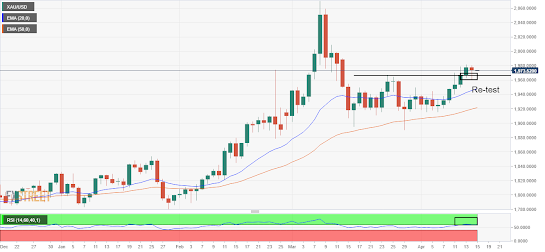
The bulls are in control and taking on fresh highs. On a daily scale, XAU/USD has tested the breakout of its previous critical level at March 24 high $1,966.18 multiple times. The 20- and 50-Exponential Moving Averages (EMAs) are scaling higher, adding to the upside filters. The momentum oscillator Relative Strength Index (RSI) (14) has overstepped 60.00, which indicates a firmer bullish momentum going forward.

Remarketing tags may not be associated with personally identifiable information or placed on pages related to sensitive categories. See more information and instructions on how to setup the tag on: http://google.com/ads/remarketingsetup --------------------------------------------------->